
A Journey to Russia – Impressions of Saint-Petersburg

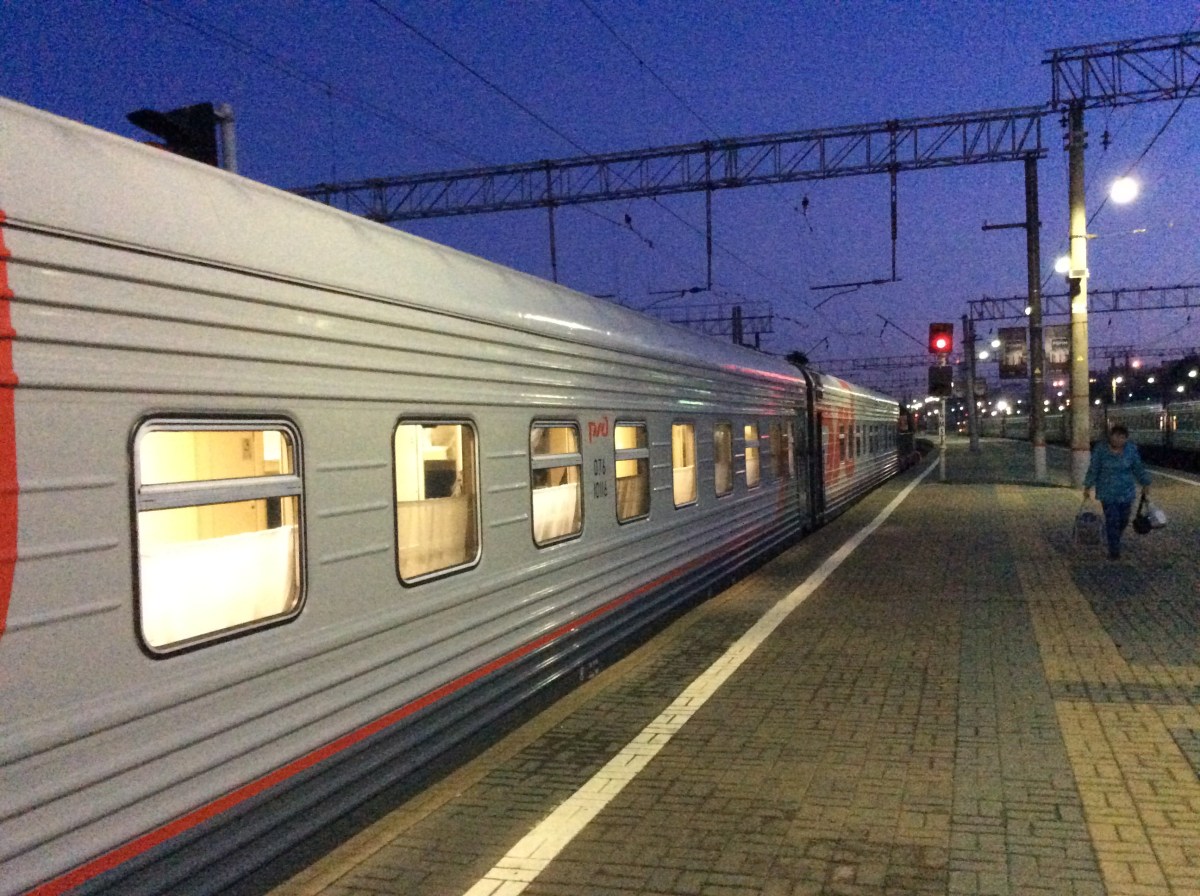
On Sunday, 23 October, Brian, David, Erica and myself took the fast train from Moscow to Saint-Petersburg. We began a five day journey through this remarkable city, accompanied by Volodya, our intrepid guide and interpreter Our itinerary included tours of museums and visits to projects working for the most vulnerable in the city. In between we met people in their homes and eating places and heard many opinions and many stories. For me, the stories tell me more than the opinions.

It was interesting being in this complex and historically important city. While being aware of the breathtaking beautiy of this ‘Venice of the North’ I never forgot the human cost of its construction. In order to make real Peter the Great’s audacious vision of a magnificent city creating a window on Europe, thousands of slave labourers died as its magnificent buildings took shape.

Our knowledgable guide shepherded us through the city he obviously loves and we found ourselves caught up in his enthusiasm. With him we visited the Hermitage, the Summer Garden, the Church on the Spilled Blood and St Isaac’s Cathedral. I think my favourite tourist exclusion was our boat trip on the River Neva. This was on a chilly but sunny day and I was delighted to find that I could follow the Russian commentary, not with ease but I had some idea of what we were being invited to look at! My spoken Russian is really weak but I did notice in our various encounters that I understood a little of what was being said before the interpretation.

Ou guide knew of my interest in Russian literature and he pointed out places associated with Pushkin and Dostoevsky. As a result I’m re reading ‘Crime and Punishment’ and Pushkin’s great poem, ‘The Bronze Horseman’.

We learned something of the challenges of life in this city for the poorest people when we visited two charities and heard about these issues from the workers. They told us, and others confirmed this, that the most vulnerable people in society are the elderly. Pensions are meagre and older people are susceptible to scams which can result in them losing their modest accomodation. It was heartwarming to see the genuine concern of the young workers at the homelessness project for the elderly.

On an overcast and snowy morning we went by bus to the Piskaryovskoe Memorial Cemetery. In silence we reflected on the hundreds of thousands who had died during the nine hundred day Siege of Leningrad during the Great Patriotic War. Our guide told us that his mother had been a young woman during this tragic time and this reinforced our awareness that everyone we met in Saint-Petersburg had relatives who had lived through it, and sometimes had died during it. We learnt that the experience of war on its own soil has given the Russian people horror at the thought of war again. Here is a
translation of a text carved on a granite wall at the cemetery:
Here lie Leningraders
Here are city dwellers – men, women, and children
And next to them, Red Army soldiers.
They defended you, Leningrad,
The cradle of the Revolution
With all their lives.
We cannot list their noble names here,
There are so many of them under the eternal protection of granite.
But know this, those who regard these stones:
No one is forgotten, nothing is forgotten.

I’ve spoken about the visits to people’s homes and we were shown warm hospitality. I just want to mention one woman who really impressed me. I shall call her Katya. She is a bit younger than I and a lively, friendly woman. Soon after our arrival she showed us several large photograph albums which contained hundreds of photos of her family. Her father had been a keen amateur photographer. While looking at the albums we learnt about her life and the fact that her father spent some years in the Gulag. She said this probably saved his life as it meant he wasn’t fighting in the war. As Katya spoke, and like many Russians I’ve met she told a good story, I was struck forcibly by the awareness that life in Russia for those of our generation was vastly different from life in Britain. This is why it is so tragic and unacceptable that elderly Russians are neglected.

The four of us had long journeys ahead to reach our respective homes and I, for one, appreciated the hours spent at the airport as I was able to reflect on all we’d experienced. One final anecdote though. As I’ve mentioned this was my fourth visit to Russia and on the other visits I’d spent time in Perm. The friendly woman on the British Airways desk at Domodyedovo who took care of my disability assistance, was from Perm! What a coincidence!
A Journey to Russia – Memories of Conversations – The Gulag and Human Rights

After our meeting at FHM on Thursday, we went to the Museum of the History of the Gulag. For us this was a preparation for our visit on Friday to the Memorial Human Rights Centre.

The Gulag Museum was relocated and reopened last year and it is a sobering experience to walk through the exhibits and, in my case, to listen to the audio descriptions of the various areas. I read a BBC News report about the reopening of the Museum which pointed out that recent Government policy has been to play down Stalin’s record of terror and instead speak more about his role in defeating Nazi Germany in the Great Patriotic War. This is not to say the terror did not happen, just that the blame was not all at Stalin’s door. This seems to me to be a sensitive subject and I was not ready on this visit to raise it with anyone.

On Friday morning we went to visit representatives of the Memorial Human Rights Centre. With regard to the Gulag Museum, Memorial told us that they had provided the bulk of the archive material and exhibits but I got the impression that that was the extent of the contact.

I had heard of Memorial’s historical work when I learnt about Perm-36, a museum created on the site of a forced labour camp outside Perm, a city I have visited three times. As I understand it, and I could be mistaken, Perm-36 used to be a Memorial project and we learnt that now it is administered by local government. Again, I felt unable to pursue this further on this occasion but I am going to make some enquiries. I think, and again I could be wrong, that one difficulty is that Perm-36 housed nationalist prisoners from former Soviet states and the recent upheavals in these states make this faxt an uncomfortable one. In holding up Perm-36 as an example of Soviet repression it might be thought that the aforementioned nationalist prisoners were seen with sympathy as they had been imprisoned there.

Memorial is a human rights organisation, an historical museum and archive, and an educational forum. They work within the states of the former Soviet Union and, as laid out in their Annual Report 2013-14, their human rights work covers; identifying and documenting human rights abuses, distributing information about human rights abuses, providing legal aid to victims, representing victims in domestic and international courts, writing reports and analysis and presenting these at meetings in Russia and abroad.

The historical archive and the educational programmes serve to keep alive the memories of the victims of the Gulag and to show younger generations that the time of terror is part of the history of Russia. Remembering helps to ensure that it cannot happen again. Young people visit Memorial and engage in educational programmes and study exhibitions like “Art and Everyday Life in the Gulag”.

During our visit we were shown precious archive material which had been lovingly preserved by families of those in the camps, such as a note written on a flimsy cigarette paper and thrown from a train window in the hope that it reached the recipient. It did!

In contrast to this single testimony we were told of the largest collection of letters in the archive; thousands of letters, delivered to the Memorial office in three trunks, written by Lev and Svetlana Mishchenko during their fourteen years separation, first by his being in the army during the Great Patriotic War and then by his time in the Gulag. Lev sent the letters Svetlana wrote to him back to her so that a detailed record could be kept. British historian, Orlando Figes has chronicled their story in ‘Just Send Me Word’.

Memorial has been under threat for the past few years as it was considered to be a ‘foreign agent’ as it receives money from overseas for its work. A list of supporters includes the Embassies of Great Britain, France and the Netherlands as well as Amnesty International. One of our group spotted a donor he’d heard of and it gave him pause for thought but I think I’ll check out the donor groups which are unfamiliar to me, just for interest.

I believe that Memorial does great work and the staff we met are certainly committed. As we were leaving we saw boxes of candles and were told that on the following Saturday there would be a vigil in Moscow where the victims of the Gulag would be remembered with the lighting of candles and the reading out of names.

A fitting memorial.

A Journey to Russia – Memories of Conversations -Meeting Quakers in Moscow


I’m letting myself off the hook by calling these pieces ‘Memories of Conversations’. This is by no means an exhaustive report of the many conversations we had but is simply a record of what I remember and what made the deepest impression on me.

During our three full days in Moscow we spent time at Friends’ House Moscow and attended a Meeting for Worship. A staff member at FHM gave us an overview
of the work they are engaged in and the challenges this presents. Here is a quotation from the most recent annual report:

“Friends House Moscow is a small non-governmental nonprofit organisation that funds projects for peace and civil society in the former Soviet Union. FHM supports projects which work in such areas as human rights, education, restorative justice and non-violent communication. Each project also furthers social goals such as grass-roots collaboration, equality and non-violence.
The work of Friends House Moscow reflects the deepest values of the Society of Friends (Quakers).”

FHM also engages in translating Quaker texts into Russian. We were shown examples of the most recent publications.

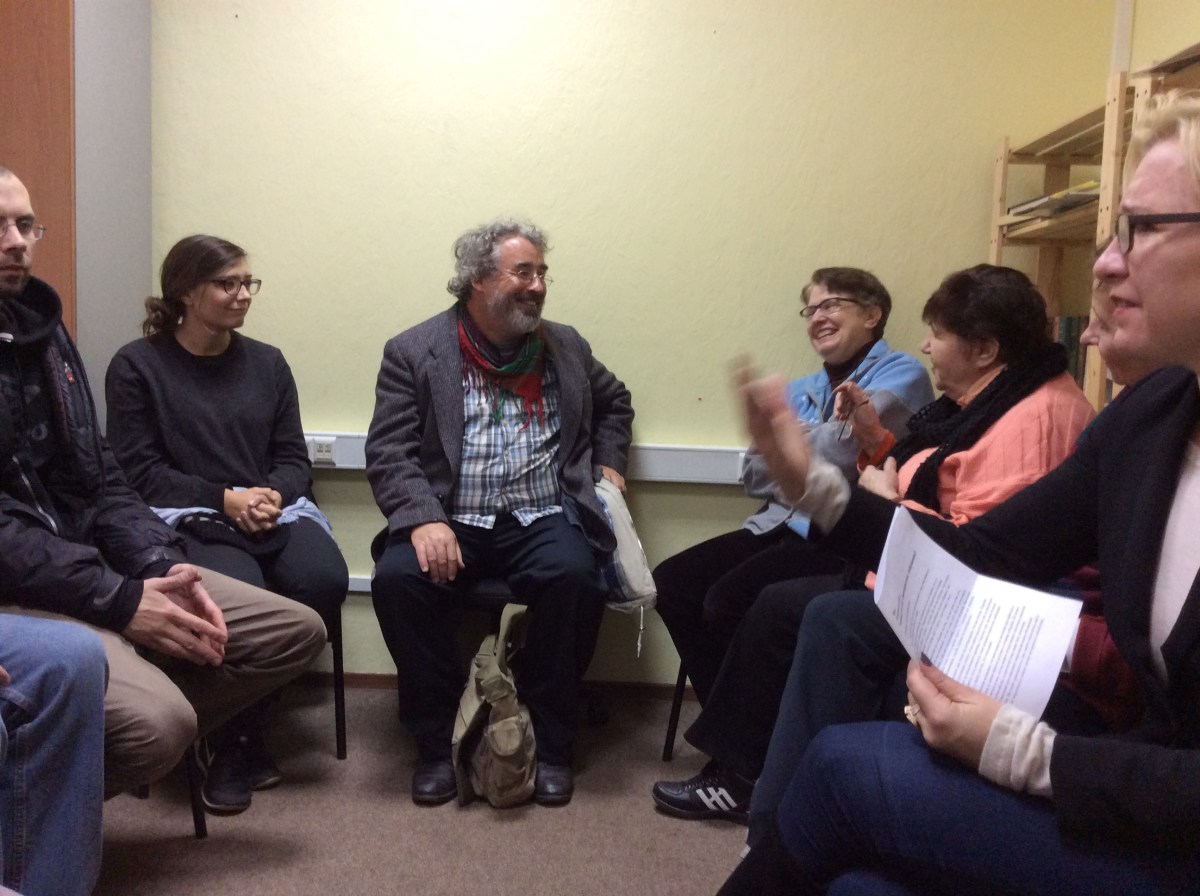
On Saturday afternoon we attended Meeting for Worship and met some of the local Quakers. After Meeting we had opportunity for tea, cake, informal discussion and sharing of experiences. All four of us found this encounter enjoyable and informative. I’ve found the Russians I’ve met on my visits to the country to be very forthright and disinclined to engage in small talk and this can lead to lively debate. One point I remember which was repeated by other people we met was that as Russia had suffered so much in what we call World War Two and Russians call The Great Patriotic War, they are determined that they should never experience war again.

As a Quaker I was so happy to meet up with Moscow Friends. I have been asked to serve on the Board of FHM and have accepted. I look forward to further contact with these warm hearted and hospitable people.

A Journey to Russia – Overview


A week ago in the early morning of Saturday, 29 October, I said goodbye to my three travelling companions in a chilly Moscow railway station. We had spent ten days in Moscow and Saint Petersburg, meeting and talking to Russians about life in Russia and the current tensions between Russia and the West. We are part of the group Voices for Creative Nonviolence. My three companions, Brian, Erica and David, are from the U.S. where VCNV was formed during the 90s. A UK branch was formed in 2012 when a group of us travelled to Afghanistan to visit the Afghan Peace volunteers. Thee have been several delegations since then, both from the U.S. and Britain.
This small VCNV visit to Russia is a recent development and I feel proud to have been part of it. So, what did we do and, more importantly, what did I learn? I can’t speak for the others and I look forward very much to reading their reflections but I thought that for myself I’d like to put down a few impressions of our visit and then write more pieces focusing on specific aspects.
This was my fourth visit to Russia and I have written elsewhere in this journal about previous visits. This was the first time, however, that I had spent more than a few hours in Moscow and the first time I’d visited Saint Petersburg.
We stayed in hostels in both cities. They were warm and welcoming places to stay. In Moscow we were joined by a guide and interpreter, Salla, who was an invaluable companion. In Saint Petersburg Volodya, a native of the city, acted as guide and interpreter. His love for his city inspired us as we walked the streets once walked by Pushkin, Dostoevsky and many other writers and artists.
During our ten days we met Quakers in Moscow, representatives of Memorial, a human rights group in the same city, and, in Saint Petersburg, we met groups working with vulnerable people in the city, language students and friends of Volodya and his wife who invited us int their homes.
We visited various museums in both cities connected to the recent history of the former USSR as well as the world famous Hermitage. We also visited several churches in both cities which were either places of worship or museums. A particular highlight for me was the boat trip we took on the Neva and the canals of Saint Petersburg.
Since returning I have been reflecting on this visit against the background of anti Russian sentiment presented in the media. I keep revisiting in my mind the people we met and the things they said. My next entry will focus on this.