1963 The Beatles in Bradford

1963  age 17

For ages I’ve been telling people that I saw the Beatles at the Bradford Gaumont in 1964. This isn’t true; I saw them on the 21st of December 1963. It appears that this was the second time they had played in Bradford in 1963. They returned once more in October 1964, but I have no recollection of that visit.

Listening to music and learning about the ‘pop stars’ of the day, was a very different experience in 1963 compared to today. I first heard about the Beatles because they had a radio programme  at 5 o’clock every Tuesday evening on what was then the BBC Light Programme. This was really the beginning of their growth in popularity. Their first record, ‘Love Me Do’, was not a hit but the second one, ‘Please Please Me’ went straight to Number One and from then on any Beatles’ record went straight to the top of the Hit Parade.

I used to enjoy watching the popular music programmes which were on TV: ‘Top of the Pops’, ‘Six Five Special’, ‘Oh Boy’ and my favourite, ‘Ready, Steady, Go’.  It wasn’t possible to record programmes in those days and I can remember rushing home from Leeds, where I had spent the afternoon, hoping I would be in time to see the Beatles on a programme the name of which I’ve forgotten, one Saturday. 

The first record player I ever owned was an old wind up gramophone which only played 78 rpm records. When I was about 15 my auntie passed on an electric record player which had belonged to one of my cousins. On this I could play 45 rpms  and Long Play records. My mum wouldn’t let me buy any LPs but I did acquire quite a few singles and some Extended Plays  which contain four songs. I had a few Beatles EPs and I used to play them in the kitchen when nobody else was around. This wasn’t too bad for Beatles songs because the adults quite liked them but it became a real issue when I got into Bob Dylan when I absolutely had to be on my own to listen to him. That’s another story
In 1963, I was a student at Bradford Technical College, studying for  GCE ‘O’ Levels. I had been at Temple Bank school from the ages of 5 to 16. There is much more about my time at Temple Bank elsewhere. My school did not offer GCE exams at that time which is why I went to BTC.  We had the majority of our classes in the city  centre on Drewton Street which no longer exists. It was an old building and I think I heard that it had originally been Saint Bede’s Grammar School.

Our course was a two year one. Most of the students were from secondary modern schools which did not offer GCE and there were a few pupils from private schools who had failed their exams. We had to take six subjects. I chose English Language, English Literature, Spanish, Geography, Religious Knowledge and Biology.

A friend from my Spanish class and myself decided we wanted to go to see the Beatles. At that time the teenage girls in Britain were in the throes of Beatlemania. It was known that everywhere the group went they were mobbed by excited fans.  Buying a ticket to one of their concerts was quite an endeavour. Sue and I were not planning to go together; she was going with her friends and I was going with one of mine, but we did meet up to go and buy the tickets.

We had to go to the Gaumont on one Sunday evening.  The box office would open at 6 pm and the tickets would be sold on a first come first serve basis.  This meant turning up early.  We gathered outside the Gaumont and the queue stretched right around the building and goodness knows how far up Sunbridge Road. It was cold and dark and I didn’t realise how worried my mum was about my coming into town to buy the tickets. Fortunately, my sister‘s fiance had a van and my mum persuaded him to come and pick me up when it was getting late. He arrived around 10 or even later, we were approaching the box office but it was obvious that the tickets were running out. I bought two tickets one for myself and one for my friend whom I had persuaded to come with me. I felt relieved when Fred appeared and came with us to the ticket office. We bought our tickets and one of the staff members insisted that we put them away safely before going out into the crowd. I think the tickets cost 12 shillings and six pence.

The friend I went to the concert with, Kathleen, lived near us on the new Allerton council estate and we went to the same church. We became friends because her sister was in the church choir as was I and that’s how we met. To be honest we were both a bit strange. Neither of us had many other friends and we were really on the fringes of groups. We both thought we were better than everybody else. Many years later at her funeral her brother told me that he had to persuade her to go to the Beatles concert. I was absolutely enthusiastic about it but I think for her it was a bit too much like doing what everybody else was doing. 

During the concert, especially when the Beatles came on stage, there was a lot of hysterical screaming which was quite common at Beatles concerts then. Kathleen and I refused to scream; we were far too cool, although we did actually stand on the seats so that we could get a better view.

People young and old are still impressed when I say I went to see the Beatles. One day, though, someone will say, “Who were the Beatles?” and I’ll stop telling the story.
1947

My mum used to tell the story of her brother, Billy, who insisted that he was a year younger than everybody said he was. His reasoning was that during the first year of his life he was only 0. I can understand his thinking, perhaps it is a family trait. When I thought about writing about the first year of my life I was going to call it 1946 but I was born in the middle of November 1946 and most of the first year of my life was in 1947 so I’ll stick to that.  Uncle Billy would understand.

The winter of 1947 is famous for being extremely harsh. I was blissfully unaware of this, of course, as I was of any hardship that the people of Bradford were suffering a year or so after the end of World War II. I was unaware also that I had a mum, a dad and an older sister. The fact that my father had served throughout the war on an aircraft carrier and had experienced many life threatening dangers as the ship sailed thousands of miles around the world, was completely unknown to me in  1947.

Let’s name my family. Parents, Richard and Alice Clarkson, older sister, Moira. When I was born I believe it was my sister, six years old, who named me. She probably didn’t know but the name Susan was the most popular that year. Hence there are many women of my age who are called Susan or Sue or even Susie. I always felt somewhat disappointed that my name was so common and, ironically, my sister really disliked her own name because nobody else was called Moira. It was only in a conversation last year that we discovered that she always thought our mum had given her that name but in fact my mum told me that it was my dad. He had been doing some painting and decorating in a house and the family had a little girl called Moira who apparently was very sweet. He suggested the name to my mother. This issue of our names is quite interesting because I think Moira always wanted to fit in with everybody else whereas I always wanted to be different. 

My parents were married in 1936.  My mum was from an Irish family of mill workers. She grew up  ‘back o’t’ mill’ in the shadow of Lister’s Mill.

As far as I can make out my dad is from a Yorkshire family of mill workers. He was born in the magnificently named Tumbling Hill Street, very near the centre of Bradford. The university is now built on Tumbling Hill Street and I find that quite poignant. My dad, like many people in the early 20th century, was very clever but was unable to go on to further education because of the finances of the family.

My dad was born in 1908 and my mum in 1912. I know  World War I had an effect on both families but I have not yet found out what that might be. I know that my father’s parents, Emily and Bennett, married before either of them was 20 so my dad had really young parents. On the other hand my mum’s parents were older when she was born .She was the youngest of five. Her mother, Annie Cannon, died of Spanish flu in 1916. Her father Edward Cannon – I think they called him Teddy – died before my mum married.

I am at present finding out more about my family history through the Ancestry website.  Sifting through the regular emails from Ancestry containing hints about my relatives, I am becoming familiar with the names of my ancestors.  As well as my parents and grandparents, I am getting to know my great grandparents; Jane and James Clark, Richard and Elizabeth Clarkson, Solomon and Mary Longbottom and Michael Cannon and  his wife, my, as yet, unknown great grandmother from Barnsley. 

I don’t have family of my own although I have nephews, and niece, great nephews, great nieces and even three great great nephews and a great great niece. This is why I like to name and muse about my ancestors as they appear in the story of our family.   I have even discovered two great great great grandfathers who were born in the 18th century, Simon Clarkson and Stephen Longbottom. The search continues…

Back to the winter of 1947. Again I was completely unaware that I was born with a disability. At first they thought I was blind as my eyes had not formed properly but in fact I did have some vision in my right eye which has served me well over the years. It was an extremely difficult time for my mother. Not only was I born with poor eyesight and other health issues, but my dad was in hospital suffering, I think, from his first heart attack at the age of 38.  Sadly, our dad died in 1952.

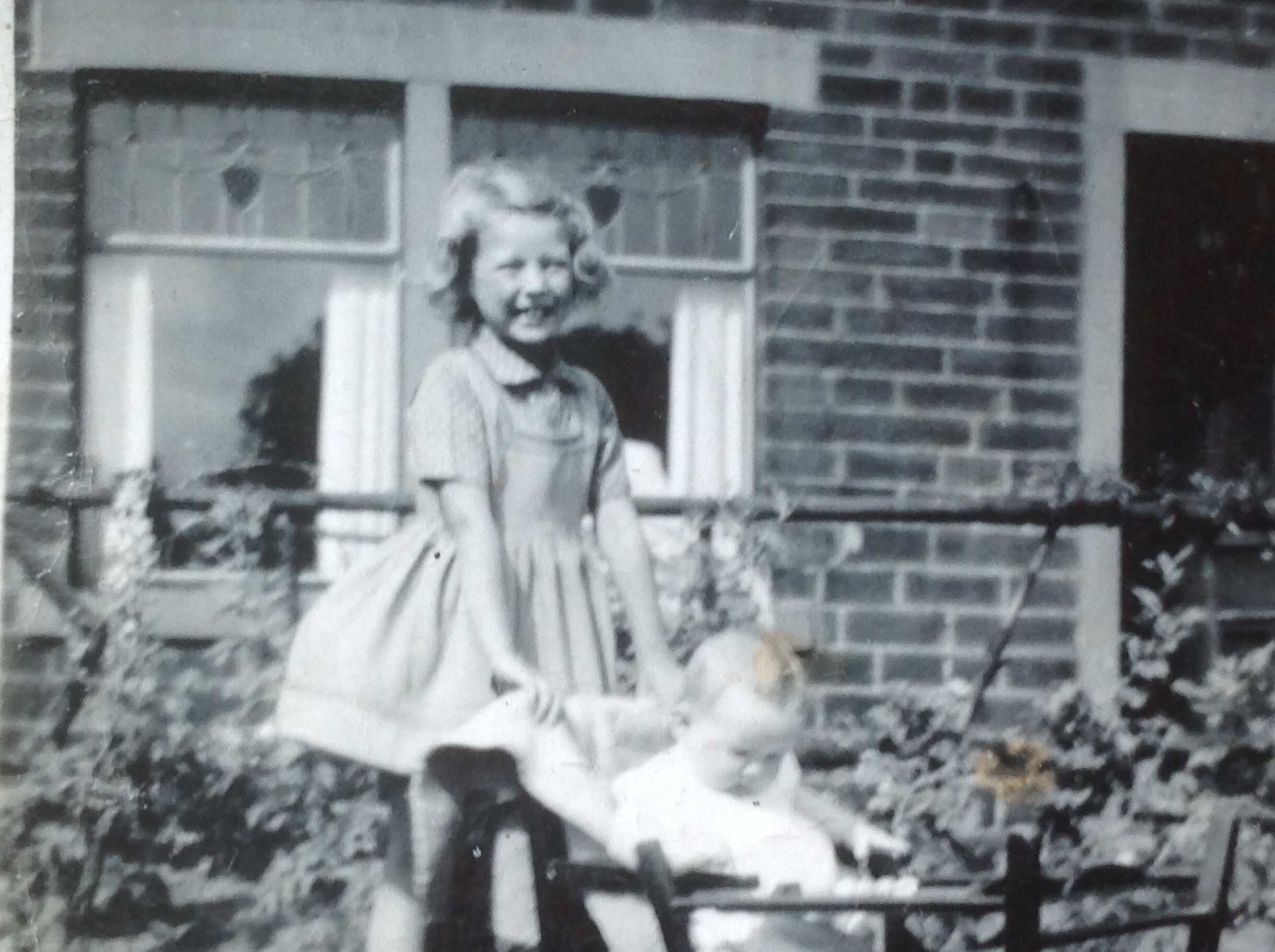
Despite the harsh winter, the summer of 1947 was warm and sunny, at least if a little group of photographs taken in our front garden are anything to go by. My dad must have taken the photos because he isn’t in any of them. There is one with my mum sitting on the grass and holding a ball in front of me, I think to see if I was able to see and reach for it, and there are two with me and my sister. My favourite is one where I am in a small chair and Moira is standing behind me.  She is beaming, standing very straight with lovely blonde curls and in what I assume to be a very pretty frock. I am only a few months old and I seem to be intent on gazing at my foot. I think by that time they  knew I wasn’t blind. Apparently, my dad used to sit in front of me and roll a ball to see if I would see it coming. It seems that I was able to reach for the ball if it was on my right side but not on my left. I’ve also been told that my dad noticed that when I started to crawl I would knock into things on my left side, the side with the sightless eye.

In the garden on that sunny day with my sister, I could certainly see my foot and found it most interesting.

Here is a poem I wrote about this photo

Summer 1947

Baby

In the garden

Big sister, pretty dress,

Curly blonde hair, smiling sweetly,

Happy.

She looks

At her father

As he takes the photo

Of his two little girls, so soon 

Bereft.

He leaves

Few memories,

But precious nonetheless,

Of joyful days and bitter loss  

Hearts rent.

Memoir and Poetry

I mentioned before that I have been following some Creative Writing courses over the past few years. Although I’ve written a few short stories, I’ve discovered that what I really like to write is poetry and memoir.

Recently I have been attending some online courses organised by The Arvon Foundation. One such course was a day Workshop on memoir by the writer, Richard Beard. During the Workshop he told us about a project he has developed online called the Universal Turing Machine. This project is well worth looking at and I won’t attempt to describe how ambitious a project it is, anyone who is interested can look it up.

From Richard Beard I got the idea of writing a 1000 word piece on a year in my life. If I did every year I would have an 80,000 word tome but I am starting simply. I have already written one piece on 1947, the first year of my life, and I have started to write a piece about 1963 when I saw The Beatles in Bradford. I am just going to take it one piece of writing at a time. I’m not going to attempt to write chronologically but just to choose years which stand out for me. 1000 words are just right for me. My short stories are never more than 1500 so, I’ll keep it short and simple.

So, where does poetry fit in? Writing poetry is something which is very new for me and I enjoy following forms but I’ve also experimented with free verse. I have already written a short three stanza poem to a company my first piece of memoir and if I feel inspired I may write a poem to accompany each years memoir. This will only happen if I feel inspired!

Finally, I have signed up for a course on Arvon at Home which takes place during the month of October online, one day a week. The theme is Memoir and Poetry and I am really looking forward to it.

On First Hearing Haydn’s Creation

On First Hearing Haydn’s “Creation”

St George’s Hall

21 March 2026

Enfolded in the golden glittering glow of the concert hall,

we sat entranced by softly sweeping orchestral chords.

Then, chorale, tenor, soprano, baritone

swept us away in soaring sounds,

proclaiming Light and the birth of creation.

Scriptural song blended with Milton’s verse

as joyful, haunting harmonies rang clarion clear 

in the early spring evening.

 Choir, orchestra and soloists  created the dazzling vision.

While Raphael, Gabriel and Uriel sang,

aerial war was waging in the Middle East

cradle of creation.

Weapons, not angels, winging their way,

drones of destruction bringing devastation and death, 

mutilating creation so lovingly lauded in angelic song.

What help is there for the bereaved and bereft?

Only the wounded healers

limping among them, 

lamps lit with the flickering Light of hope

The Poet and the Painter

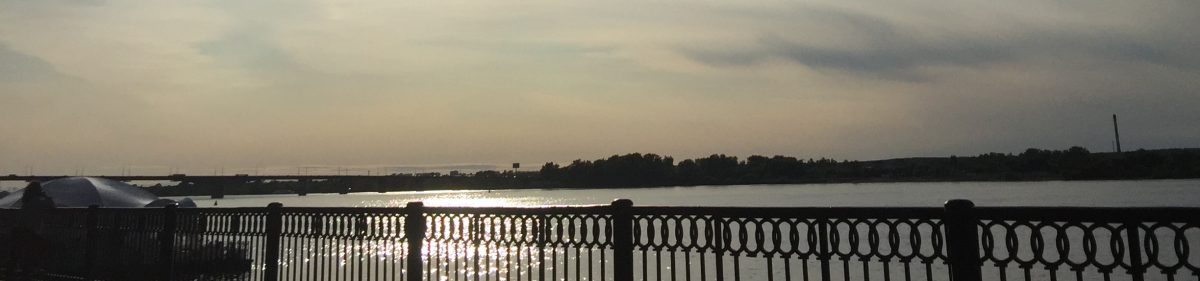
I have been experimenting with writing poetry since I joined the Creative writing class a couple of years ago. This poem is a memory of a wonderful week on the river Karma, Russia

he Poet and the Painter

Five sun warmed lazy days,

the river mirroring the blue haze above.

On deck kids play.  Mayakovsky gazes

silently

while in the lounge, bathed in blue,

the piano murmurs softly-

French sonatas 

on a Russian afternoon.

We are cruising  towards 

Kazan, Tatarstan.

On the way we pause at

Yelabuga,

small town, nestling on Kama’s bank.

Here Shishkin was born,

the wanderer who celebrated far flung forests in paint.

For Tsvetaeva the town meant

exile.

Her poems tore open her tortured heart.

Then, bereft of family and friends,

deep in despair,

she took her own life.

Ivan and Marina-

birth and death

In that little town.

We go back to the boat, the 

Mayakovsky

and make our lazy leisurely way 

to where the Kama meets the Volga,

to

Kazan, Tatarstan

One Day In Bradford City Centre…


Shirley stepped off the bus at the end of Thornton Road into the bright, spring sunshine. After the harsh winter she was delighted to get out and about again. The chaos caused by the redevelopment of Bradford city centre hadn’t helped over the past months but now she had a new spring in her step – if a spring it could be called, considering her arthritis.

 She walked along the last bit of Thornton Road, passing the huge edifice of the old Gaumont, now called, she believed, Bradford Live, whatever that meant.  She crossed Godwin Street and walked down the gentle slope towards the mirror pool in Centenary Square. The fountains were  dancing in the sunshine and she was admiring them, and the backdrop of the City Hall, when suddenly, there were two angry voices yelling at each other and a screech and a crash. She turned to the right and saw a woman of about her own age and a young man shouting angrily at each other. It seemed he had been cycling at great speed down the slope from the traffic lights into Centenary Square, without taking any notice of the strolling pedestrians. He had knocked into the shoulder of the woman and sent her bulky bag flying. Shirley thought that the woman must be feeling shock and anger which was making her yell so furiously at the abashed cyclist. He and his bicycle had crashed to the ground and Shirley approached the two of them just in time to hear him say, ‘I’m really sorry!’ The woman glared at him.

 ‘And so you bloody well should be!  You’ve no right  careering down like that. And you should be more careful of folk walking about’. 

He picked up her bag and shamefacedly handed it to her.  Shirley could see the woman was still very shaken and she approached her. 

‘Excuse me, love, would you like to come and have a cup of tea in the Cake’Ole? I was just going there myself. Come on, my treat’. 

The woman was still shaking. Shirley noticed she was small and thin, “bird like” is a phrase often used to describe elderly people.  Shirley herself was not “bird like”, more “comfortable and substantial” as Jane Austen would say. ‘ Thanks, I will. I need to sit down anyway and get my breath back after this idiot knocked me over.’

‘I didn’t knock you over’ mumbled the contrite cyclist.  

‘No’, said Shirley, ‘You bumped into her, but I did hear you apologise so be on your way and remember, this is Bradford not the Tour de France.’

The young man hurried away.  Shirley put her hand on the other woman’s arm and led her towards the Cake ‘Ole. 

It was warm for early spring and Shirley suggested they stay outside and sit at one of the metal tables. The woman agreed and sat down.

‘They’ll be out in a minute with the menu and they’ll take our order. Have you been here before?’ Shirley asked. 

‘No, I haven’t. I don’t often go into cafés but I do like Greggs, they’re always nice when they serve you.’

‘The people who serve here are nice as well. I come here quite often and they always recognise me.’ 

At that moment a young woman approached with the menu on the clipboard and a beaming smile.

 ‘What would you like today, ladies?’ Shirley winced; she hated to be called “lady”. It was a generational thing, she supposed. Having been influenced by  feminism in the 60s, she always referred to herself and other females as “women” but she didn’t react. 

‘I’ll have a flat white and some fruit toast, please.’ said Shirley. ‘What would you like? I’m sorry I don’t know your name.’ 

‘Maggie.’ 

‘What do you fancy, Maggie?  My treat remember; you’ve had a shock’ said Shirley, suddenly aware that she was sounding a bit patronising. 

‘O.K. then,’ Maggie chuckled, ‘I’ll have a hot chocolate and a piece of carrot cake. I need a sugar rush to get over that stupid accident’ 

‘My name’s Shirley, Shirley Carter. How are you feeling now, Maggie? They really are a menace, some of these cyclists. Sometimes I think they do it to show off. They think they have the moral high ground because they’re not driving cars.’   

Maggie coughed.

‘Do you mind if I have a cigarette?’

 ‘Go ahead. We’re outside.’

Maggie lit up and sat back. 

‘What do you think of the reconstruction here in the city centre?’ asked Shirley.  ‘I quite like it now even though it’s been a bit of a pain getting around, especially with the interchange being closed for so long’. 

Maggie smiled.  

‘I like the way you can walk about without thinking about buses and cars running you over and I think it’s going to look really nice once Norfolk Gardens is finished.’

She paused, looked around and then went on.

 ‘I expect you and I are a similar age, really, so we’ll remember Bradford differently.

‘Yes,’ Shirley replied. 

‘I left Bradford when I was nineteen but I have been back on visits over the years.  I decided, when I turned seventy, to come back and retire here. I live in sheltered housing now in Girlington and I really like it. The theory was -ha ha- that I would be able to walk into town from there but actually my arthritis has got worse and the roadworks on Thornton Road make it impossible to walk on the pavements safely.’ 

Maggie nodded.  

‘I live up Great Horton Road, just up there, past the university.  Sometimes I find it difficult walking up the streets with all the youngsters just meandering around not walking straight or looking where they’re going but just – I don’t know – wandering aimlessly, especially those going up to Bradford College. It’s funny, though,’ she laughed, ‘I was a student at Bradford College myself in the 1960s and I’m sure we used to saunter just like they do and never thought anything of it. It wasn’t here though. There was an old building in Drewton Street which was part of Bradford Technical College and that’s where we had the O level classes.’

Shirley gasped, ‘Me too! What years were you there?’

’63 to 65.’

‘Same as me! I did my O levels in 65 but we did the actual exams up Great Horton Road.  Maggie, Maggie – I remember you! We were friends. I was Shirley Delaney do you remember me?

Maggie laughed but didn’t say anything as the waitress came just at that time with their drinks, the cake and the fruit toast. When she had gone, Maggie said,

‘Flippin’ heck I do remember you. Do you remember we used to go into the Ranch coffee bar sometimes at dinnertime until we got barred? We used to meet up with some of the lads from Carlton Grammar.’

‘I do remember being barred. Wasn’t it because of something you said to one of the staff?’

Yeah, it was. It was meant to be a joke but he didn’t take it like that. I also think they thought we were there too long and didn’t buy enough tea and coffee.’

‘We had to find somewhere else to go after that but it was never the same.’

Maggie stirred her hot chocolate and ate a piece of carrot cake.

‘It’s funny we should meet up here because just over there was where the Alassio coffee bar was.  Where that patch of grass is, facing the old Odeon. Do you remember it? I used to go there loads.’

‘ Yes, I do remember it. I used to go in as well sometimes on a Friday afternoon. We had biology lessons up at the old building on Great Horton Road and we used to go into the Alassio afterwards. My mum didn’t like me going in there, she said there were drugs, so I used to be really nervous going in and out in case somebody saw me and told her.’

They sat in silence for awhile, thinking about their younger selves and their friends.

‘Now, what about queueing for four hours on a Sunday evening over there at the Odeon for tickets for the Beatles concert?  I think it was called the Gaumont then.’

Maggie laughed.

‘Oh yes! And when we went to the concert we refused to scream so we were the only two silent people in the whole of the theatre. We thought we were so cool – better than everybody else ‘cause we didn’t scream!  We always thought we were better than anybody else.’  She looked thoughtful at this comment and shook her head but said nothing else.

Shirley passed over this and continued enthusiastically.

‘It was great though, wasn’t it? And people are still impressed when you tell them you went to see the Beatles. I’m just waiting for the day when I tell somebody that and they say “Who are the Beatles?” I’ll stop telling the story then.’

The two of them carried on swapping memories and laughing at events and people from the 1960s.  They recalled the clubs they frequented, like the Dungeon, the Market Tavern and the Little Fat Black Pussycat under Sunbridge Road. They chuckled over the recollection of seeing Rod Stewart in his very early days in the Dungeon, supporting the lead performer, Long John Baldry. Neither of them had felt Rod Stewart would go very far!  

When they had exhausted memories of the two years when they had been friends, there was a pause. Shirley wondered if it would be a good idea to move on to how their lives have been in the intervening years.  She herself felt quite guarded about what she would reveal.

‘So, Maggie how are things been for you?  What did you do after O levels?’  Shirley remembered Maggie as being the cleverest and most original student in the year.

‘I did think about carrying on to A levels but actually I joined my brother, working in the office at his electrical business. We did really well for several years but then life got a bit grotty. I got married but that didn’t work out and now I’m on my own. I do have two kids but they don’t live in Bradford and I’ve lost touch with them. How about you?’

Shirley sensed that her former friend wasn’t too keen to go into details about her life and she understood this. She chose her words carefully and was selective about what she revealed, telling Maggie about how she had gone on to study French and Russian  at university and had become a teacher for a few years. She passed over any reference to her personal life and spoke at greater length than she might normally have done about her year in France, In order to avoid any questions about personal stuff. 

Shirley was surprised and pleased when Maggie suggested they get together again. She mentioned that there was an exhibition at Cartwright Hall in Mannningham Park that she was quite keen on going to, and wondered if Shirley would like to come too.

‘Yes, I’d like that. Are you free on Friday?’

Maggie nodded and added,

’I’ll meet you in front of Cartwright Hall.  Is eleven O.K. for you? We could look at the exhibition and then have a sandwich in that lovely café they have. I promise I won’t try to make any inappropriate jokes with the staff!’

Book Worm

Book Worm 

Susan Clarkson

In the 1950s, six of us lived in a back-to-back house in Bradford. We were four adults and two children. My mum, my eleven year old  sister and myself, aged five, had gone to live with our auntie and two uncles not long after the death of my dad.

There were always books around the house, mainly library books, and books which had been passed on to various members of the family by other relatives or friends.   One such relative was Auntie Anne, who was actually a member of a book club and so she used to pass on books she had read onto my Auntie May, my mum’s sister with whom we lived, who was a keen reader. 

One such book was the newly translated English edition of “Doctor Zhivago”. This novel by Boris Pasternak, had been banned in the Soviet Union and had been translated, first into Italian and then into English.  It received a great response in Europe and the U.S.

I was in my early teens when this book first appeared in our house. I was already an enthusiastic reader but there was a great deal in the novel that I didn’t understand.  However, it woke in me a love for the idea of Russia and all things Russian. The novel opened up for me not only this mysterious and secret land but also an awareness that very often people who keep their independence of thought and action, as did Yuri Zhivago, generally suffer for it.

Around the same time we acquired a television and I can remember watching a series of Shakespeares history plays,, starting with “Richard II” and ending with “Richard III”. This project has been repeated several times since on TV but I do remember very vividly this first one in black and white which was called “An Age of Kings”. I certainly understood very little of Shakespeare’s poetry but I was fascinated by the stories and by listening to the language. 

As a result, one day, I found myself near a secondhand bookstall in Kirkgate Market.  I picked up and put down several books until I came across a heavy, dark blue  volume, “The Complete Works of William Shakespeare.’ It was quite dogeared and a bit grubby but I spent my pocket money on it – two shillings and sixpence – and took it home. To everyone else it just looked like a tatty old book but to me it was wonderful. I was able to read some of the speeches that I’d heard on the television production and began to understand them a little more. I also delved into some of the other place, the ones I had heard of, “Romeo and Juliet”, for example, and “Hamlet”.

Before discovering Pasternak and Shakespeare, Auntie May had taken me to my first library, Manningham Library on Carlisle Road. I thought it was absolutely wonderful, not just the books but also the setting which was quite ornate and light.  I loved walking around the brightly coloured shelves of books in the children’s section, knowing I could choose one to take home.  

I joined Manningham Library as a junior reader but later on progressed to the Bradford Lending Library in Darley Street.

This library was opened in 1878, having moved from the original library on Tyrell Street which was opened in 1872. As far as I can recall, there was a big heavy door leading into the library from Darley Street.  I have a feeling that this was the only frontage because as soon as you went through the door, you were in a dimly lit hallway with a large staircase in front of you. Usually, I went to the lending library on the first floor to search the shelves for my next book.   

I recently found a photograph, on a local history website, of the lending library in Darley Street. It was packed with people standing in between the huge bookcases choosing their books.. The photo was taken in 1962 so perhaps I was one of the readers!

At that time all the books were hardback books and many of the older ones were beautifully bound, thanks to the skills of the librarians. By the time I started to use the library newer books retained their original dust covers which were protected by plastic so the shelves were a combination of dark book spines, with gold lettering and much more colourful volumes. The light came in from  beautiful arched windows, a bit like the ones we can still see on the Wool Exchange, but there were also lamps hanging from the ceiling. I loved being in that building, searching for, finding, and always leaving it with a new treasure.

 Wherever I moved to a new town or city, I always found the nearest library and joined.  As well as remembering particular libraries, I find that I call to mind certain books which I found, borrowed and read. For example, it was in the library at Sittingbourne, a busy town in Kent, that I first found the novels of Melvin Bragg. This was in the 1970s, and he had only written two or three books but I really enjoyed these stories which were a mixture of social history and an evocation of place, in Bragg’s case, Cumbria. I still read a Lord Bragg novel, now and again.

After Sittingbourne, I moved to the mining village of Wath upon Dearne in South Yorkshire. In the cosy, welcoming library, next to the baker’s, I found a huge scholarly  volume in defence of Richard III, and I date from that time my devotion to this much maligned monarch.  I even started to write a story about Richard as a child in Middleham, but nothing came of it.

In Oxford, I joined the local public library.  My sight was failing rapidly and I depended on audiobooks and large print books. I ordered a large print version of “War and Peace”. This comprised seven large volumes which were kept in the store, and when I went to  collect them from the library, there was great amusement among the library staff. Occasionally I used to put one of these huge volumes in my bag and go and sit on a bench in Christchurch Meadow, on the bank of the Thames, and lose myself in the lives of Natasha, Pierre, Andrei, Maria and Nikolai. 

While living in Oxford I was able to use the  Bodleian Library.  A good friend worked in the Disability and Inclusion office at the University and often asked me to join teams looking at disability issues in the different buildings and colleges, especially issues those connected to visual impairment. One of the perks of this consultation work was access to the Bodleian and a readers’ ticket. 

Technology for the use of visually impaired people was in transition at that time, around 2006, and the library possessed a huge piece of equipment which readers with limited sight could use in order to read books.  The text to be read was placed underneath a light and on a large screen it appeared magnified several times.  I was allowed to use this reader and to be perfectly honest I’m not sure how many other people did.  At the time I was doing a course on Dickens at the Oxford Department for Continuing Education and so I was able to do research in the library, accessing books and using this extremely heavy and cummbersome machine.

All I had to do was to call the library and book a slot and when I arrived the reader was set up  waiting for me. The staff were friendly, accommodating and fascinated by the machine.

It gave me a great thrill to walk through the imposing quadrangle leading to the main entrance, Duke Humphry’s library in front of me. The buildings in the quod glowed with a rich honey colour. On entering the library I was able to use my card at the turnstile climb the ancient wooden staircase to the first floor and then enter the calm and brightness of the reading room, finding my special desk.  Before beginning reading, I would look out of the large windows overlooking the spectacular Ratcliffe Camera and fantasise that I really was a student at the University of Oxford.

One thing I was never called upon to do was to take the solemn undertaking required by all uses of the library. It would have been fun to do that.  I still enjoy reading the text to myself:

“I hereby undertake not to remove from the Library, nor to mark, deface, or injure in any way, any volume, document or other object belonging to it or in its custody; not to bring into the Library, or kindle therein, any fire or flame, and not to smoke in the Library; and I promise to obey all rules of the Library.”

Creative Writing

I have been taking part in creative writing classes since last summer. They take place in the library in the centre of Bradford. I have also joined a small online writing group which meets on Wednesday evenings. I am enjoying writing again and to my great surprise I have even attempted some poems. My intention is to post some of this writing here on my blog and possibly also on Facebook. The story called the Piccadilly line is one of my first attempts. My feeling and also the feeling of others in the group is that memoir is the way I should go and I’m now going to put on a memoir about reading

The Piccadilly Line

The Piccadilly Line

Julia let herself out of the front door of her block of flats into the crisp, sunlit air of Islington. She walked  along Mckenzie Road, admiring as usual the prettiness of Paradise Park on the left. She turned to the right and reached the main road. The traffic was already heavy although it was only 7:30 am. Using the pelican crossing, she headed towards Caledonian Road tube station. Tapping her Oyster card, she joined the growing throng waiting for the lift to take them underground.

The westbound platform was already heaving but she knew that if she positioned herself at a certain point she would get a seat. Moving carefully along platform she reached her goal. Checking the indicator she noted that fortunately the train she needed, the one going to Heathrow, was the first one. The train approached, slowing down. The doors opened and she stepped inside turning to the left and taking the seat vacated by a young woman. She breathed a sigh of relief.  As this was a train going to Heathrow, very soon it would be full of people with travel baggage of various shapes and sizes cluttering the carriage.

She remembered the times she had taken this journey to Heathrow in the days when she travelled abroad for work and for holidays.  Nowadays she stayed in Britain although she did have plans to travel in Europe by train – someday.

The train trundles towards King’s Cross where many more passengers entered the carriage. Julia was used to travelling on the underground and it didn’t bother her that they were all packed in. She sat back and reflected on how often over the years  she had travelled on the Piccadilly Line.

She knew the stations by heart and as her ultimate destination was Osterley, she began to reflect on the parts of her life punctuated by the various stops on the Piccadilly Line.

As the train made its way through central London, Julia allowed her mind to pick up fleeting memories at each of the familiar stations. Meeting Friends in the Italian café in Russell Square during lunch hours when she had worked at the British museum. Opera at Covent Garden, The to visit Leicester Square, leisurely walks through Green Park and Saint Jameses Park.  

However, she found that her memories were beginning to focus on the eventual destination of a journey, Osterley, and on Hounslow Central. It was with thoughts this latter station that she found the memories and emotions were the most vivid and painful.

Three years earlier she had been living in Oxford in a small faith based community which gave hospitality to five asylum seekers. One of the young men, Nazar, had to go to Eaton House, the immigration reporting centre in Hounslow. She had agreed to accompany him as it was his first reporting session since leaving detention.  

They caught the bright blue and red Oxford Tube bus which ran frequently between Oxford and London, leaving it at Hillingdon, a station on the Piccadilly line. They had to change at Acton Town and then catch the train for Hounslow. After leaving the train they joined a large group of people waiting for the bus to go to Eaton House. Nazarr was actually chatting to a couple of other Afghan men and it was obvious that the bus had many people whose destination was the IRC.

It was a bright sunny day and people were queueing up to go in to the unattractive and functional building. Julia asked the guard if she could accompany Nazar as he was feeling a little nervous but the guard refused, saying that it was for her own safety not to allow her into the building just in case something “kicked off”.

Naza grinned nervously at her and then joined the queue which was moving quite swiftly. Julia stood outside with those waiting to enter, admiring some of the brightly coloured clothes that some of the women were wearing. 

Time passed.

She gradually became anxious and then really worried when she realised that people who had gone in after Nazar were now coming out again. She approached the guard at the door and asked where Nazar was.

“I don’t think he’ll be coming back with you so you’d best go home.”

“What do you mean? I really need to speak to someone to find out what’s going on.”

Fortunately the guard said, “Wait here.” 

After about 20 minutes an immigration officer came out and took her to one side, explaining that Nazar would not be leaving with her but would be taken to an Immigration Removal Centre near Heathrow Airport. He gave her the name of the centre -Colnbrooke – and a phone number so that she could call for information.

Sitting on the Piccadilly line train three years later she remembered how she had set off on the journey back to Oxford with a sinking heart and an overwhelming sense of powerlessness.

Even after three years she remembered the painful experiences of visiting Nazar in Colnbrooke.  No need for the Piccadilly Line now; she took the green and yellow bus which ran between Oxford and Heathrow and then caught a local bus to the large forbidding IRC. Nazar, just seventeen, had often wept and because there was a language barrier which neither of them could breach, all she could do was sit holding his hand or with her arm around him. It was a massive wrench to leave him each time she visited and she once she wept  loudly and openly after she had left him, feeling again the powerlessness but also rage.

As the train slowed down approaching Osterley, Julia remembered that Naz story, as far as the Oxford community was concerned, had a strange and yet unbelievably helpful ending. He had been released from the IRC but was told he would have to be attacked taking his chance he simply disappeared she assumed he went underground and she did receive a couple of short phone calls from him saying he was okay. He was a very resourceful young man and she didn’t doubt that somehow or he would survive. Watt remained was the mixture of happy memories of him and the painful remembrance of his tears.

Leaving the tube station Julia set off to walk the short distance to the small retreat centre where she was to meet her spiritual director.  Centre was not very big but was surrounded by pretty gardens and many trees These monthly visits where a source of peace and refreshment to her in her busy life but as she reflected on her own comfortable life, she was left with the question why people who didn’t deserve it, like Nazar and countless others, were given a difficult path to tread.

As if in queue, an aeroplane pled the sky noisily overhead as it left Heathrow. She wondered as she dead if that plane was carrying refugees away from the country which they had thought to be safe and welcoming

A Surprise Letter

One Tuesday morning last autumn, I woke early and, as usual, felt very pleased that it was going to be a day off work, which I could spend reading, writing and doing my washing. An ordinary Tuesday.

After breakfast I heard the letterbox snap and went to the door without much enthusiasm. It would probably be the usual fliers, promotional stuff, nothing personal. Then I saw something which sparked my interest. it was a cream envelope and the paper was of a very superior quality. My name was printed on it with the correct address. Could it be a circular? I turned it over and saw the address of a solicitors I’d never heard of: Green, Blackwood and Murgatroyd.  I sat down in the window seat where I had placed my mug of coffee, opened the letter and read it. 

It told me that a relative of mine had died and that they had left me the contents of a storage unit. I was puzzled because the name of my deceased relative was unknown to me – Mrs Emily Alice Ridewood. Emily Alice had lived in Taunton, miles away from my own Yorkshire home. However, the storage unit in question was actually on the outskirts of Bradford, my city. The letter also told me that I could collect the keys to the storage unit from a local solicitor at my earliest convenience. 

I read the letter three or four times to give time for this strange and exciting news to sink in. The name Emily Alice Ridewood was new to me. I had no knowledge of any distant relatives.  I needed to do some digging…

A few phone calls to family members revealed little except that Emily Alice had been my mum’s second cousin.  I engaged the help of my best friend, Margaret, who went online to discover more information. Sure enough, Emily Alice had been born in Bradford in 1920. She had grown up in the same street as my mum; one of several in the rows of back-to-back houses behind Lister’s Mill. My mum, eight years older, had sometimes looked after Emily when she was growing up. In 1939, Emily had married a young naval petty officer who was sadly killed when his aircraft carrier was attacked by a Japanese kamikaze pilot, not very long before the end of World War II.

Emily had discovered that I was the only living relative of my mum, of whom she had been really fond. Emily had never remarried but had settled in the south of England as a nanny and then a housekeeper to a large family.

So far so good. I was beginning to warm to Emily already and really cherished the connection with my mum.

A few days later, I contacted the local solicitor and collected the keys to the storage unit.   Margaret came with me. It was my first visit to such a facility, and I found it a bit creepy; all those big containers and locked doors and the grey, utilitarian decor. It looked like something from Soviet Russia.

We sorted out the paperwork with the chap in charge and he told us how to find Emily’s possessions.

With a mixture of excitement and trepidation and a certain amount of unease, I unlocked the door. In the storage unit, underneath the large, deep green dust sheet, was a beautiful ornate antique bureau. I gasped. It was so lovely with intricate marquetry depicting woodland scenes. There were trees, flowers, grasses and small animals all made out of delicate shapes in wood veneer in a riotous variety of golden shades. The legs were curved gracefully and were abundantly decorated with tiny flowers in the same wood veneer.

The desk had obviously been well cared for. There was not a mark on it and the wood glowed richly. There were several compartments and drawers of various shapes and sizes. Most of them were empty but in one of them we found a small bunch of keys. Some of the drawers were locked even though most of them were empty. 

However, in one of the larger compartments in the centre of the desk, we found a box covered in a rich purple velvet. One of the keys we had found fitted the lock of the box but we decided not to look at it immediately but to take it home.  We returned to the reception desk and  arranged to have the bureau delivered to my home.

We left and on the way back my mind was full of Emily and her treasures. What would this box reveal about Emily? I thought of her as a child being looked after by my mum. I thought with sadness of her as a young widow and of her life in service with this unknown family. Was she homesick for Yorkshire? Did she eventually have a happy life? Would I know her better when the contents of the box on my lap were revealed?

Arriving home Margaret and I first of all put on the kettle for a cup of tea. We looked  around my spacious garden flat near Manningham Park, discussing how to rearrange the furniture to give my newly acquired antique bureau a home. 

Margaret and I sat at the kitchen table looking out at the autumnal colours in the garden, and I was reminded of of the richly coloured decoration on the precious desk which was now mine.

We placed the purple velvet box on the table between us and unlocked it with the small tarnished key. Before opening it we mused together about what it would contain.  Letters? Possibly. Jewellery? Also possible. Photographs? Hopefully. 

There were five items in the box; a packet of letters tied up with string, a wedding ring and engagement ring, a photograph, and a sealed envelope. 

The photograph was of a wedding party. As was the custom in the 1930s, the group stood in front of a curtain in a photography studio. The young bride, Emily, who was only nineteen, her husband, a little older, in his naval uniform and a few other guests. To my great delight the maid of honour was my own mother, looking radiant. 

Despite my joy at seeing my mum, I was, of course, much more focused on Emily, for it was she who had unlocked her memories for me. 

The wedding ring and engagement ring I assumed to have belonged to Emily. They were so small and delicate, a thin gold band and a silver one with a single tiny diamond.

The letters were the most poignant. They were the letters she had received from her husband during his time at sea on the aircraft carrier, HMS Indomitable. No eloquent phrases here, no love poems, no opening of his heart to his young wife. Instead the letters were simply expressions of his affection for her and responses to the day-to-day news she had given him in her letters. Mundane possibly, but in his simple words the love he had for Emily shone through.  He even occasionally corrected the spelling mistakes she had made in her letters to him, gently and with humour.

Finally, I opened the sealed envelope.  In it Emily had written how she had come to own this antique desk.  It had been given to her on her retirement by her employers.  The family she had worked for had been  descendants of Russian emigres who had left Russia before the Revolution, which is why they were able to take some of their possessions with them, including this desk. Another document in the envelope gave full details of the provenance of this piece of furniture. This meant of course that it was an extremely valuable antique and Emily intimated that if I wished I could sell it.  I didn’t want to – it was so beautiful and so  full of history.  What was most precious to me in this legacy from Emily was the brief glimpse into her life and the connection it gave me to a piece of my own history.

Above is the first story I have written as part of the creative writing class I have joined