On the week end of 3-5 February 2017, Quakers gathered at Wooodbrooke Quaker Study Centre for a conference called ‘Forced Migration: How Can Quakers Respond?’ This conference was organised jointly by the Quaker Asylum and Refugee Network, Quaker Council on European Affairs, Quaker United Nations Office, Quaker Peace and Social Witness and Woodbrooke.
I’m a very inactive member of QARN but I decided to go along in the hopes that I might get inspiration to continue working with asylum seekers and refugees, although I realise the experience I had while living and working at St Francis House can never be replicated. I’ve just started volunteering with Bradford Ecumenical Asylum Concern, BEACON, and also hoped the conference would help me make the transition from the work in Oxford. What follows is a very personal reflection on the week end. The QARN website and Facebook page will give a more detailed picture of the event.
http://www.qarn.org.uk
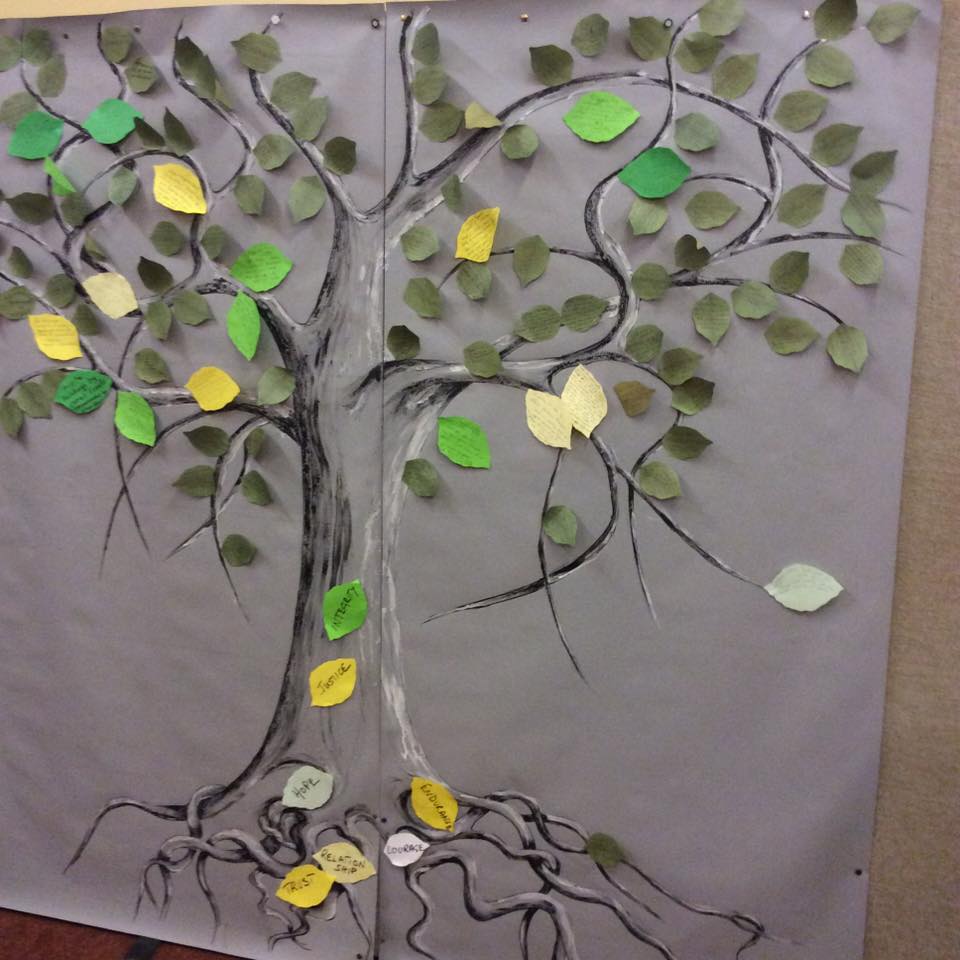
As the conference began we were shown a drawing of a winter tree with no leaves. We were asked to write aspirations, inspirations, hopes, reflections and concerns on paper leaves and stick them on the tree over the week end. On my leaf, the one and only leaf I took, I wrote ‘Remember Rahmat and Nazar’. These four words came from a very deep place inside me and have a real story attached to them.
One of our guests at St Francis House was a young man named Rahmat. He was Hazara from Afghanistan, as were all our Afghan guests. One wet and cold day in May, 2009, Rahmat went to Eaton House in Hounslow for his routine signing. He never returned to us. He was detained and was told that he would be removed back to Afghanistan. We visited him several times during the weeks before his removal. He was in one of the detention centres in Gatwick. Efforts to obtain his release failed and on our penultimate visit he had a request for us. An Afghani teenager, Nazar, had been in the detention centre for several months. He was told he could leave if he had somewhere to stay. Rahmat asked if he could come back with us to St Francis House. We said yes. We made arrangements with the authorities and Nazar was allowed to come and live with us. So, on our final visit to Rahmat on the day before his removal, after an emotional farewell, we met our new young friend, Nazar. It was as if Nazar were Rahmat’s farewell gift to us and it says much for Rahmat’s generosity of spirit that he took Nazar under his wing at a painful time for himself. Even more poignant is the fact that Nazar was not Hazara but Pashtun but this mattered not one bit to Rahmat; Nazar was a youngster in need of help and Rahmat helped him.
Nazar adapted really well to life in Oxford. He made friends with other young teenage asylum seekers, played cricket and displayed intelligence and resourcefulness. His parents had been fearful that he would be forced to join the Taliban and had sent him out of Afghanistan, He followed the long dangerous route we know so well now and ended up with us. Not for long though. He had to sign at Eaton House every fortnight. I accompanied him for the first couple of times but then he went alone. For some reason in the summer of 2009 I went with him again. He didn’t come out for a long time so I went to enquire where he was and was told he was being detained in Colnbrooke, Heathrow. Visits to Nazar in Colnbrook were distressing; he was distraught each time I went and we had such a sense of powerlessness. However, one evening in August I heard the front door open and there was Nazar, beaming from ear to ear. They had released him with no explanation. All was not well, however, as he had paperwork to say that he would be tagged the following day and subject to curfew. One of our other guests explained this to Nazar and he became thoughtful. The next day he disappeared before the security man came.
Over the next few months Nazar telephoned just to say he was O.K. Although I haven’t heard from him for a long time he is always in my heart. As is Rahman, back in Afghanistan, married with children but finding it difficult to find work. Because of the way the stories of these two young men interweave they have a special place in my memory but all the guests who lived with us at St. Francis House are special and have their own stories of courage and endurance.
It was an awareness that asylum seekers and refugees are human beings with names, stories, loved ones, joys and sorrows which impelled me to write the names of Rahmat and Nazar on the tree at Woodbrooke.
The tree started as a winter tree with bare branches but ended the week end as a tree in full leaf and flower. I stayed an extra night at Woodbrooke and the chilly but bright early Monday morning sent me to T.S. Eliot’s ‘Little Gidding’ and hiss musings on midwinter spring ‘when the short day is brightest with frost and fire’.
Inspired by our winter tree bursting into life, one participant quoted from the Book of Revelation 22:2, echoing Ezekiel 47:12:
On either bank of the river were the trees of life, which bear twelve crops of fruit in a year… the leaves of which are the cure for the nations.
 Live Adventurously