Final draft of Tenx9 Story

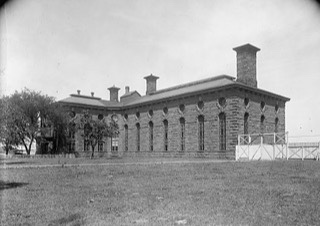
One hot steamy morning in Washington DCin 2003 I went with my young friend Liz to visit our friend, Gary, in DC gaol.

Liz and I were living in the CW community in DC and Gary was a member of Jonah House in Baltimore.  Both communities were, and still are, dedicated to serving the poor in the neighbourhood by providing shelter and food and taking part in nonviolent direct action against all forms of war and war making.  At that time all community members in both communities were white.  The people we served were either African American or Latino with a small number of white Vietnam war veterans.  Both our community, in the Petworth area of DC, and Gary’s, in West Baltimore, were in predominantly poor Black neighbourhoods of our respective cities.

Gary, originally from Madison Wisconsin had been found guilty and sent to jail for a nonviolent protest at the Pentagon.  I can’t remember the length of his sentence but he was in DC so Liz, originally from the Virginia suburbs of DC, and I set off to visit him.

The forbidding building of the jail loomed ahead as we took our places in a long queue of African American and Latino visitors, mainly women and children, some babes in arms.  We had been warned that visiting was a long process so we were prepared to wait.  

The queue moved at a snail’s pace so imagine our surprise and acute embarrassment when an official came up ti Liz and myself and escorted us to the front of the queue.  There was one grumbling in the queue but not much.

They checked our ID and processed us.  Ther was a brief delay when the guy questioned whether my passport was valid ID in the US.  So much for the request in the front of the passport from Her Brittanic Majesty’s Secretary of State requiring I be allowed to pass freely without let or hindrance – but I digress.

Liz and i were led to thee visiting room.  We sat in front of a glass screen and Gary was brought in  on the other side  We had to speak via telephone with him.  Honestly, it felt like being in a film except it was our friend who was incarcerated and sitting on the other side of a glass screen.

Gary was pleased to see us and we exchanged news, then Liz and I had to leave.

It had been an hour since we had been taken to the front of the queue and as we descended the shabby stairs we met the women who had been near us in the queue.  They greeted us with cheery smiles and asked if we’d had a good visit as we passed.

Outside the sun was blazing and the air humid.  The visiting queue was even longer and Liz and I , lost in thought, made our way across the car park, heading back to Petworth and home

“Privilege” – A story For Tenx9

This is a story I have written for the storytelling group I belong to, Tenx9.  We meet every month and have a different topic.  Nine people have ten minutes to tell a true story from their lives inspired by the topic.  Since going online we are advised to write our stories and, although I usually just tell mine, I have found the discipline of writing it really helpful to me.

Our topic for this month is “Privilege”  and apparently many people have offered a story.  I do usuallly tell a story so I don’t mind if this month I don’t share. ‘Tis topic is timely and challenging for me on so many levels.

I usually dictate my story on to the iPad and then tidy it up a bit, making sure I don’t over run the allotted ten minutes.  Once I’ve posted this I’ll pare down the story for telling on Friday to keep to the time.

So, here goes.

I’ve been challenged over the last few weeks about my whiteness, my white privilege, white supremacy and how I behave. I don’t mean I’ve been challenged by people but by events.

A few of my friends and I doing a course organised by Quakers called “Black Lives Matter: Whiteness and Racial Justice Learning  for Quakers” That will be the last mention of Quakers because what I am learning and what I want to write about is my personal experience of my white privilege.

I’m on a real learning journey, I’m only at the beginning of the journey and have absolutely no idea where it’s going to lead. So what I’m offering here is the first step for me on the road less travelled.

To me, my most obvious  examples of my white privilege are when I’ve been abroad. Just to summarise quickly, I spent two weeks in Cameroon and six months in Madagascar where I was teaching English. Although in Cameroon the children called “Long Nose” out after white people, it was affectionate and not malicious. In Madagascar there is a word which means “white foreigner”, “vazaha”  This was a little more problematic but very good for me because I was identified solely by the colour of my skin. I even heard other sisters in the community refer to me as “La Soeure Vazaha”Again no prejudice or persecution was there but it did give me pause for thought.

Returning from Afghanistan my three friends and I were at the airport in Turkey, at a desk asking for help, Two African men came up also needing help to find their flight, like ourselves. We noticed with acute embarrassment how the officials behind the desk  treated us with respect and the African men discourteously.

I think these examples are quite simple for me to understand but now I’m going to talk about my time in the United States. 

I was living and working in communities which worked with vulnerable people, giving hospitality to those in most need and sharing food on the street. The communities I worked with were in Los Angeles, Washington DC, New York and Baltimore.

Nearly every community member, no matter which city, was white. Many of them had lived in those communities for decades and I am in great admiration at their commitment and fidelity but now when I think about it those communities were places of white privilege. We couldn’t have joined those communities if we didn’t have a load of security behind us.  One example for me is the fact that I have had a British passport for forty years which means i can travel nearly everywhere without let or hindrance and have never been refused a visa.  Hence I was able t spend two years in the States with no problems.  (Actually, there were one or two problems but that was because I got arrested several times and that’s another story!)

In Los Angeles and in Washington DC most of the people who received our food and our hospitality were either African-American or Latino. In many ways I was naive, I did ask myself why are some people so disadvantaged and others privileged including myself, but I never really connected that with race.

Two examples, one of my time in Washington DC and the other of my time in Baltimore stand out for me.

As well as giving hospitality the communities I  belonged to, Catholic Worker communities, did a lot of non-violent direct action and one of our friends was in DC jail. Myself and a young member of the DC community, Liz went to visit him.  We joined a very long queue of visitors waiting to be admitted. Imagine our embarrassment when a guard came up to us to take us to the front of the queue. Everybody else in that queue was African-American or Latino. To be fair, perhaps if we had both been young it might not have happened and of course I did have my white cane. They insisted that we be processed quickly and taken up to visit our friend, Gary. After our visit as we left the visiting room and went down the stairs, we passed several people who had been in the queue waiting with us. Many of them greeted us in a really friendly fashion and asked us if we’d had a good visit.

My second example is from Baltimore, West Baltimore to be exact, made famous by the TV series “The Wire” The community, Jonah House, was again  all white and again people who had given their lives to the service of others.  They still do.

Each week food was collected are donated and we made up food parcels. On a  designated afternoon people from the neighbourhood came to collect their parcels. All of them were African-American. The community members always greeted their neighbours with graciousness and friendliness and that particular kind of old fashioned courtesy so typical of Americans of a certain age. It was a warm autumn afternoon and we stood in the yard with our parcels handing  them to people as they arrived. We had the radio on and there happened to be that afternoon a programme about the civil rights movement and the music it inspired. Having this in the background, reflecting on what had been achieved  in the civil rights movement and yet being confronted for several hours by poor African-American neighbours in need of food and other products, is an experience I shall never forget.

Over a hundred years after the abolition of slavery, decades after the civil rights movement, it was still white people giving from their abundance and the poor African Americans receiving. 

As I say, I do not know what to make of these experiences, It will take time for the injustice of my white privilege to sink deep within me and for me to discern what to do about it. Also I am very aware that this journey is taking place in my own country and it is in the British context of injustice to our black brothers and sisters that I’ll need to work.  I trust God will show me what I’m meant to do.i

A Learning Journey Through Whiteness and Racial Juctice

I’m hoping to have the commitment and resilience to write over the next few weeks about my learning from the online course “Black Lives Matter: Whiteness and Racial Justice Learning For Quakers.”  I am not going to write about the sessions, just what I have learnt and am learning about my own white privilege and my commitment to racial justice.

The course willl run for five weeks and we’ll be given reading and watching tasks each week.  These, together with some reading I’ve been doing recently, will form the basis of these reflections on my learning journey.

We had a pre session questionnaire to help us position ourselves and find out about our knowledge and ignorance.  One of the questions was about the beliefs of the Black Lives Matter movement.  I visited the website of the global BLM movement and was profoundly moved by the statement ‘What We Believe’.  Here are some highlights which caught my attention.

The movement aims to build local power and to intervene where acts of violence are carried out by the state or vigilantes.

BLM aims to build a world free of anti Blackness where all thrive, and to unite Black people globallly.

The movement is committed to “healing ourselves and each other” and creating allies.

Finally, my favourite:

“We intentionally build and nurture a beloved community that is bonded together through a beautiful struggle that is restorative, not depleting.”

  The whole document is invaluable as a resource for a summary of BLMs inspiration and impetus.  I did learn a lot about BLM from the website.

Before even knowing about the Quaker course I had started to read recommended books.  Two in particular grasped my attention.  They are;

“Why I’m No Longer Talking To White People About Race”, Reni Eddo-Lodge, and “Natives: Race and Class in the Ruins of Empire”, Akala.

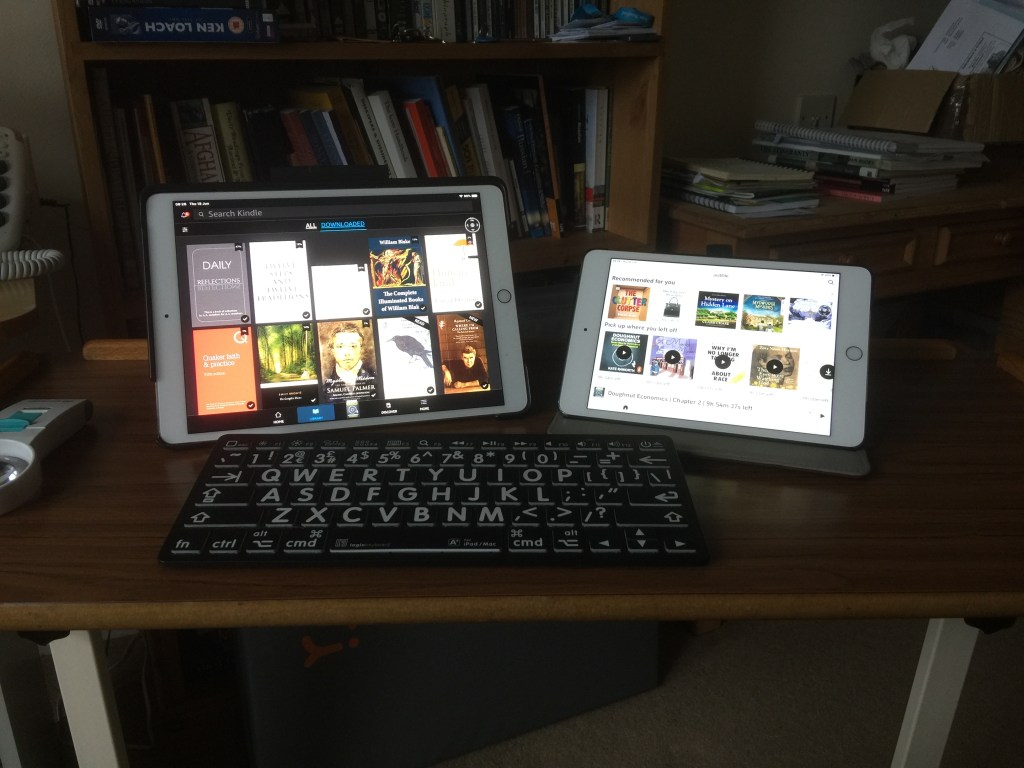
I have both books on audio, both read by the authors.  Listening to these young, passionate voices really adds, for me, an urgency to discover inside myself resources to act in the most fruitful way for racial justice.  I also have kindle versions of the books so I can easily go back to check references or read again the most challlenging parts.  I am aware that i need to do deep rooted checking of my cultural assumptions and my behaviour.

There was a non essential part to the pre session tasks.  I watched two films from the list. I chose them at random: “The Hard Stop” and “Generation Revolution”. they are both documentaries.

The first is about the shooting of Mark Duggan in Tottenham in 2011.  The film follows the campaign for justice and for police accountability.  However, the film’s main focus is on following the lives of two of Mark’s friends, Marcus and Kurtis in the daily struggle of being young and Black in Britain.  Their lives seemed to be caged in by so many barriers.  I felt drawn into their stories to the extent that I was calling out words of encouragement to them as their stories unfolded.

The second film is about a group of young Black activists in South London.  I was trying to imagine conversations between them and Marcus and Kurtis.  The different characters and motivations of the young activists came across strongly and again I felt drawn into their stories.

There is much for me to learn, much to do and much to undo.   It’s an important journey which, as we are in it for the long haul, needs to be “restorative and not depleting”

PhotButo by Anton AtanasoA Restorative and Not depletv on Pexels.com

But what is round the next bend…?A

Slow Down Reading

I’m reading  a variety of books during this time of slow down.  I’m no longer keen on the term ‘lock down’ and prefer ‘calm down’, but ‘slow down’ reflects my life and mood best of all at this time.  ‘Lock down’ was imposed on us, ‘calm down’ was how some of us treated the imposition, but ‘slow down’ for me is a really positive and affirming action.  I have no intention in the immediate future to change how I am living which is in a leisurely yet focused way.

So, back to the reading.

One major element in my choice of reading lately has been the Black Lives Matter movement and the challenge to look at white supremacy, white privilege and how they influence my life, thought and behaviour.  

I have just finished an initial reading of ‘Why I’m No Longer Talking To White People About Race’ by Reni Eddo-Lodge.  I have it as an audiobook and kindle book.  Eddo -Lodge reads the audiobook herself and this really adds to its impact.  I felt myself so challlenged at things she says that I already know which passages I’ll be returning to for deeper reflection and examination.

Another book I am using on the same theme is  ‘Me And White Supremacy’ by Laylaf Saad.  this is more of a work book with questions for self examination but she sets out the issues to be examined clearly before presenting the questions.

As a great lover of fiction I am changing my usual reading habits and choosing books by Black writers.  At the moment it is a classic American novel, ‘Their Eyes Were Watching God’ by Zora Neale Hurston.  i invariably read fiction these days via audiobooks and the narrator of this book is wonderful, her name is Ruby Dee.  The novel tells a dramatic story and has a strong main character, Janet.  However, what really moves me is the poetic and descriptive  language.

I am in a book group with other local Quakers.  We came together because we are part of the local  Roots of Resistance group, a national Quaker group set up last year to resist the Arms Fair in London last September.  Our book group is reading ‘Doughnut Economics’ by Kate Raworth.  Again i have the audiobook and the kindle.  I need to read print for nonfiction in order to take it in but the audiobook is a good supplement to print.    The author again reads the audiobook and it is fascinating.

For light relief I’m rereading Frances Brody’s series about a woman private investigator in 1920s Leeds, Kate Shackleton, a young war widow. 

STOP PRESS

I’ve just registered on an online course called ‘Black Lives Matter, Whiteness and Racial Justice Learning For Quakers’.  Looking at the reading list and tasks set, my reading for the next five weeks willl be pretty much set!

Some books in my kindle library and audible library

Where There’s A Well There’s A Way- John 4:1-42

One of the great things about this lockdown for those of us who are retired, is having time to pursue interests.  At the moment I am doing a short course on Bible Study For Quakers, run by Woodbrooke, the Quaker learning centre in Birmingham.  I was delighted to see this course offered as one thing I miss since becoming a Quaker is regular scripture sharing with others.  Being of the generation of Catholics who embraced Vatican II which, among many other innovations, encouraged us to read, study and act on  scripture, I embarked on this course with optimism.  We are looking at three books in particular; John, Ephesians and Revelation.   Here is a reflection I wrote on John 4:1-42 – The Woman at the Well 

I have always found the gospel according to John quite inaccessible. I am much more at home with Jesus in Luke, or even Mark although Mark’s Jesus is often grumpy and unreasonable. However, this story, John 4:1-42, is one of my favourites in the whole of scripture. 

I have really enjoyed returning and letting it sink in over the past few days and once again feel I know this unnamed woman. As a story it has character, movement and depth and as a text with spiritual meaning it can be pondered over and over again. I have often, over the years, used this text for imaginative meditation and have found it to be rich in meaning.

This story is far less challenging for me than many other parts of John. (I want to add here that another chapter of John, John 15, also has great meaning for me.)

This wonderful woman is an outcast and this story speaks to me of how Jesus reaches out to outcasts, (this may also be why I’m attracted to Jesus in Luke, the evangelist of outcasts and women). Her actions are restricted by the fact that she is a woman and a Samaritan. She has to come alone to the well, possibly because she is a Samaritan or perhaps because of her way of life. She is surprised when he asks for a drink of water and possibly embarrassed. While Jesus speaks of living water welling up to eternal life, she keeps the conversation practical, speaking of buckets and deep wells, shared history and her desire not to have to daw water daily.

The mood and tone shift. Now Jesus becomes practical, commenting on her many husbands, while she shifts to a theological point about worship. I like to think that her comment,’I see you are a prophet” is said with deep irony. She is feisty because she belongs to a persecuted race and gender. Her willingness to engage him in conversation elicits his response, much appreciated by us Quakers, John 4:23-4.

The drama is heightened when his disciples return just as he makes the revelation of who he really is.

She scurries away, perhaps from embarrassment but I think not. She sets off to testify and bear witness to her town.

I used to think the townspeople were a bit mean to her, saying they no longer believed because she told them. Now I see that she was in fact a witnesss of integrity. She told – she stood aside – she allowed the words of Jesus to be taken into the hearts of the townspeople, John 4:42. It seems to me that, ’We have heard him ourselves’ is a very  Quakerly response.

I don’t have a picture of a well but here is water!

Live Adventurously – Even In Lockdown/

I started this blog when I was preparing to go to Afghanistan with Voices For Creative Nonviolence UK in 2012.  The ‘Live Adventurously’ imperative comes from a text, Quaker Advices and Queries 27.

Many of the posts reflect our time in Afghanistan and many describe later visits I have made to Russia.  

However, ‘Live Adventurously’ has come to mean something very different of late.  

Even before lockdown, or calm down as I once heard it called, I have become aware that my sight was gradually growing dimmer.  Things I used to do became more difficult and sometimes I had to acccept that i could no longer do them.  An example is that last year at this time I travelled to Russia alone to spend two weeks with friends in Perm   improving(!) my Russian.  It was a most enjoyable holiday with many happy memories but I realise I can no longer travel abroad alone.  Of course Covid means I may never be able to travel abroad again but my dream is to travel to Russia overland and be in this country I have grown to love just one more time.

Meanwhile, I think living adventurously in the present situation may mean something as simple as catching a bus!  We’ll see.

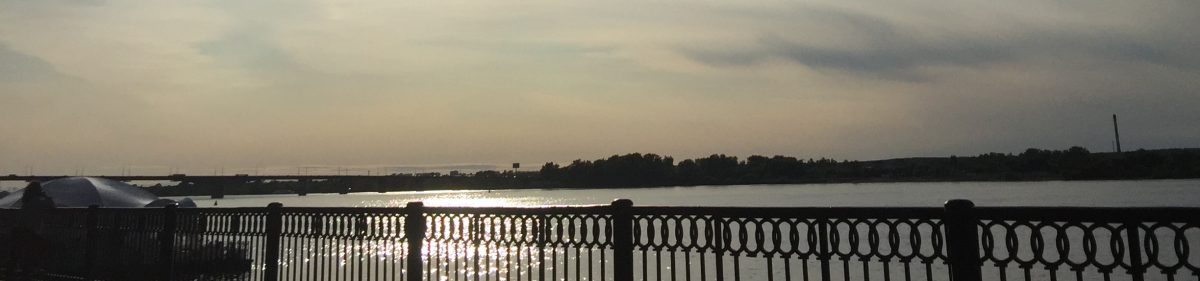
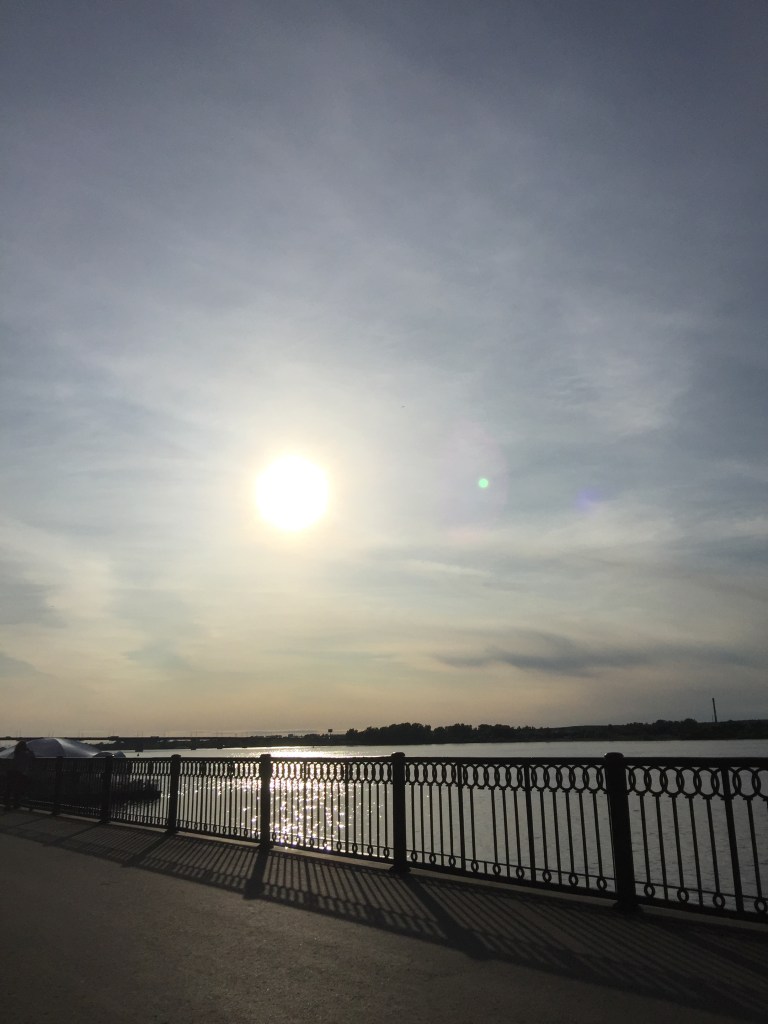
The River Kama, Perm, Russia – a year ago on a summer’s evening

Russian Soul -Rubber Soul – And Much, Much More!

Revisiting and restoring this blog I discovered I never sent this post.  It was a lovely day out in Liverpool.  Imagine, in those days you could catch a bus and a train and go where you wanted and everything…

On Saturday I took a trip across the Pennines to Liverpool to hear Karavai, the balalaika quartet from Perm, Russia, play Beatles tunes. The midday concert was part of the International Beatleweek Festival where musicians from around the world come to Liverpool each year to play the songs of the Beatles in many different musical styles and in different venues in the city, primarily the Cavern!
The Saturday concert was free and took place in the magnificent Central Library, minutes away from Lime Street Station. Karavai opened the session with a fifty minute magical mystery tour which took my breath away. I didn’t stay after the performance but understand that several of the international bands came to play in the Library up until six o clock.
When Karavai began to play ‘Here Comes The Sun’ the audience was sparse but as the music wove its magic the appreciative applause after each piece became more and more enthusiatic. As well as the four string players, the group has a keyboard player and percussion. Together they created a variety of moods from the familiar much loved melodies.
‘Here Comes The Sun’ brought tears to my eyes. It was gentle at first, just piano and then the whole ensemble took the simple evocative melody away and created something to uplift the heart. I think I cried because it made me remember how much I loved the Beatles as a teenager and how much joy they’d given to my youthful self. (And it is George’s song: we all had our favourite Beatle!) Even more than that, though, I had tears of joy for the fact that the musicians before us were from Perm, a city I have grown to love in a country which is becoming more and more important to me.
I’d like to mention two other arrangements which particularly set my feet tapping. Karavai’s version of ‘Eleanor Rigby’ is in the style of a traditional Irish band and “Can’t Buy Me Love’ soars away on jazz improvisation.
I bought the CD and am listening to it as I write. Who would have thought that over fifty years since I saw the Beatles in Bradford I would be sitting listening in Liverpool to a group of Russian musicians interpreting so creatively the musical heritage of a generation?


A New Society In The Shell Of The Old – One Quaker’s Perspective

(I wrote this piece last year after the General Election .  Since then ‘all has changed, changed utterly’ yet I still find that what i wrote then is what I would say now.  I wrote this at the request of Moscow Friends and it was translated into Russian and is on the Russian language Quaker website.)

In December we had a  General Election here in Britain and many people are disappointed and even fearful at the result.  I feel a bit conflicted; I was disappointed but not surprised.  Even more, I find I am not too despondent.  Is this because I’m an uncaring person, self centred and unconcerned?  I’d like to think not.  

I am full of admiration at the number of Quakers in Britain who worked really hard at campaigning prior to the election and I feel their pain at the result.  Many recognised that aspects of the Labour Party manifesto really echoed our testimonies. It was a Friend at our local meeting who pointed this out to me.  The Labour manifesto did promise a better life for the most vulnerable in our society yet this glimmer of hope seems to have been extinguished.

Many countries at this point in time face the reality of extreme right wing leadership.  This seems to me an indication that people of faith have a serious and challenging calling to show by new and creative means, that a better world is possible.  When I say ‘people of faith’ I mean faith in its broadest sense: faith in the basic goodness of humanity and a well grounded belief that things can change.

I think my own seeming lack of concern comes from the fact that for many years I have not placed my trust in political parties.  Before becoming a Quaker I was a Catholic and for sixteen years I lived in Catholic Worker communities in Los Angeles, Washington D.C. and New York in the U.S. and, in England, Oxford.  The Catholic Worker movement is on the radical left of the Catholic Church and is basically anarchist in philosophy.  The co founders, Peter Maurin and Dorothy Day, preferred the term ‘personalist’ to ‘anarchist’ but in effect Catholic Workers believe that we are called to build a new society in the shell of the old.  Their lives and actions all bear witness to this.  They live in communities where they give hospitality to the most needy and they engage in nonviolent direct  action against all war and preparations for war.

It seems to me that what is sustaining me during these dark and difficult days at home and abroad, is a source of strength which has three manifestations.

First, I am sustained by the knowledge that people in many countries are feeling the oppression of inadequate leadership which lacks generosity of spirit, vision, compassion and integrity.  Our leaders are failing to address the most urgent questions of the time; the devastating suffering caused by war, the catastrophe of climate change, and the ever widening gap between rich and poor.  Knowing that we share the same difficulties, though many suffer more than others, helps to create a sense of courageous solidarity and purpose.

The second source of strength is rooted in the transition I made from Catholicism to the Society of Friends. In preparing to become a Quaker I was encouraged to think about the treasures I would bring from the church I was leaving into my new home, the Society of Friends.  I did in fact find many treasures which are still with me and one of them is the influence, the inspiration, the vision of the Catholic Worker movement, along with other faith communities I have met in the U.S. and here in Britain What I learnt as a Catholic Worker was that we can all make a difference by our own faith and our own actions. Working where we are and with the people around us, we can work towards creating a better world. Dependence upon political parties, governments, leaders, is fruitless. They have lost their way and no longer act at the service of the people but in their own self interests. Yes, of course they are powerful and their decisions affect all our lives but faith that a better world is possible and a willingness to work consistently for this, can have a profound effect.  

The third sustaining source of strength is the faith and commitment of the Society of Friends.  

When I first started to attend Meeting for Worship in Oxford, I picked up a copy of Quaker Advices and Queries.  For me this text contains the essence of Quakerism and I return to it frequently to nourish my own faith.  It encapsulates the Testimonies throughout the text and not just in the numbers referring to them.  It was the Peace Testimony which drew me to Quakerism and QA&Q shows me how to live our Testimonies in all aspects of life.  

I have been pondering on the first seven sections of QA&Q over the past few weeks and feel revitalised and sustained when confronted by the darkness around us.  This text does indeed shed a light and reveals the Light within.

I would not have contemplated becoming a Quaker had I not read the following words;

‘The Religious Society of Friends is rooted in  Christianity and has always found inspiration in the life and teachings of Jesus’ (QA&Q 4)

Catholics of my generation, contrary to popular belief, were encouraged to read and study the scriptures and I always had a vivid awareness of the person of Jesus as presented in the gospels.  The query ‘Are you following Jesus’ example of love in action?’, (QA&Q no4) challenges, disturbs, and energises me.  I am reminded of the quotation from ‘The Brothers Karamazov’, much quoted by Dorothy Day, ‘Love in action is a harsh and dreadful thing compared to love in dreams’.

Accompanied by the familiar yet always surprising Jesus, I delved more into Quakerism.  The first number of Q.A&Q

‘Take heed, dear Friends, to the promptings of love and truth in you hearts.  Trust them as the leadings of God whose Light shows us our darkness and brings us to new life’,  brings me much comfort, inspiration and challenge in our troubled times.

It is one thing, however , for me to read inspiring texts and talk about being challenged by them.  How should I live in these dark days?

Last September a large group of Quakers from the British Isles and beyond, blockaded an arms fair in London by holding a Meeting for Worship in the road.  Since then a group of us in our Area Meeting, which covers a smalll part of West Yorkshire, have been meeting to pray and discern how to carry on resisting not just the next arms fair but all manifestations of  increasing greed and injustice in our country.  

We have started to study “How We Win: A Guide to Nonviolent Direct Action Campaigning’ by American Quaker activist, writer and teacher, George Lakey.  We meet regularly as a group and so get to know each other, creating a community of reflective activism.  Lakey’s book is  a handbook which draws on his rich experience of campaigning and we are learning much from it.   It reminds me of my time in the U.S. where I first encountered such community building by small groups, generally called affinity groups.  Such groups breathe life into nonviolent direct action campaigning.

At the beginning of this new year, this new decade, when the world is in a very  dark and dangerous place, I feel blessed to be a Quaker and to have the opportunity to create with other Quakers and others of good and generous heart, a world of Light, of hope, of joy.

Here are familiar, well loved, challenging words from George Fox, written in 1656 

‘Be patterns, be examples in all countries, places, islands, nations wherever you come, that your carriage and life may preach among all sorts of people, and to them; 

Then 

you will come to walk cheerfully over the world, answering that of God in everyone.’