A Visit To The North Of Ireland – A Personal, Subjective Reflection
From the 20th to the 26th of May I accompanied a group of students and staff from the Peace Studies and International Development department at Bradford University, on a study visit to the north of Ireland. I have made the decision to call it the north of Ireland rather than Northern Ireland for various reasons which may become obvious as I write. Or not…
Our journey began when we took coach and ferry to Belfast. I really appreciated the companionship of everyone and the friendship and solidarity I experienced helped to make this a memorable journey and visit. I particularly appreciated that everyone showed kindness and sensitivity towards me taking into account my age and disability.
After our pleasant, rather long but uneventful journey, we arrived in Belfast on Friday, 20th May. On our way over we met three elderly Scottish chaps from Helensburgh who were going on a trip to visit the Orange Museum! Although drink had been taken by then – not by us – we had a congenial chat.
Saturday was a really eventful day. In the morning we were taken on a tour of Belfast by the Black Cab Tours. The taxi drivers were the guides and we got a guided tour which was, in our taxi at least, entirely from the Republican Catholic side.
After this we went to the Irish Republican History Museum which had been set up by a woman called Eileen Hickey. She had been an IRA prisoner in Amargh gaol. Her sister, Susan, was one of the guides and it was a really impressive collection of Irish Republican history, carefully and lovingly curated by Eileen and now run by volunteers
After lunch we went to meet our afternoon guides.
The large group was split into two – twelve in each group. Our group started on the Falls Road, at the Divis Tower where we met guide, Danny, who had been an IRA prisoner. He took us the length of the Falls Road and pointed out notable murals on the so-called peace walls. I was shocked and saddened to learn that parts of Belfast are still segregated and that there are gates in the walls which are closed at 7pm every evening to prevent marauding youngsters from going into the opposite side.
For me the most moving moment was standing in front of a mural of hunger striker, Bobby Sands, the usual smiling, typical 1970s image which is familiar to us all.
“never, never, never
will a
martyr die,
He’ll smile upon us long from mural’s wall”
(Padraig O Tuama, ‘h u n g e r s t r i k e r s)
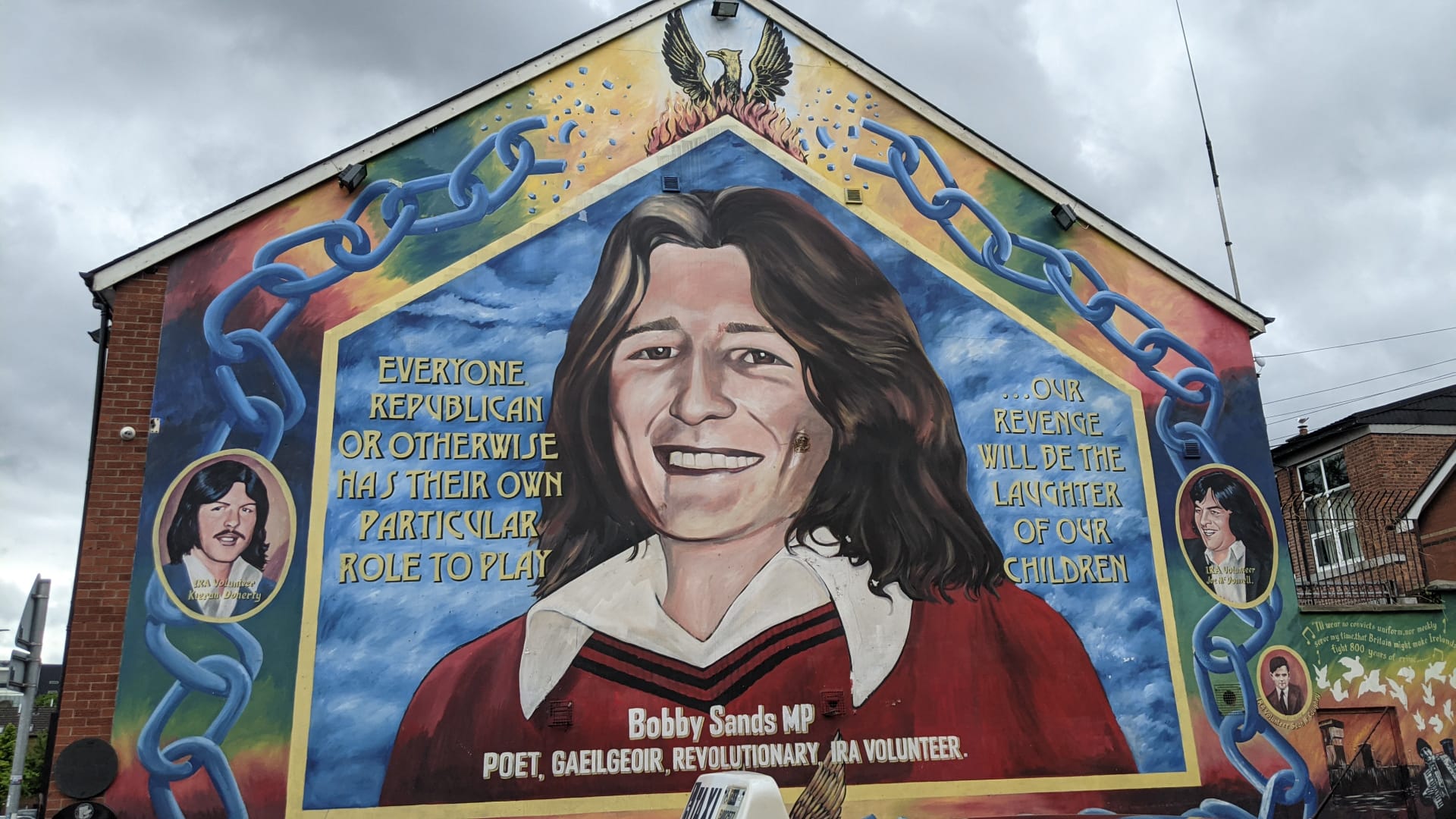
So many memories came flooding back to me of times in the 70s and 80s when I was involved with Irish friends in England and campaigning against British injustice to the people of Ireland. I never campaigned for Bobby, though, I was too wrapped up in my own petty worries in 1981 but reading “Ten Men Dead” a couple of years later really moved me to, as Daniel Berrigan says, outraged love.
Danny, who was a vivid narrator, took us to a point where we met our next guide who was going to take us down the Shankill Road. Mark had been a former soldier but he never told us that – we heard it from others. What came across to me and the others was that the Loyalist, Unionist community feels very isolated and betrayed, most of all by Britain whom they have defended so fiercely.
My feeling, and it is only my opinion, is that the Republican side have always had a great deal of support from the rest of the world because they are seen as freedom fighters and indeed they were. The Unionists have been completely on their own because not even people in Britain understand them. I could be mistaken here and as I said, it is only my opinion.
Standing before a mural of the UVF and listening to Mark, we were joined by a friend of his called Robert. Things went rather strange from that point on. Mark did as goodbye and said that Robert would finish our tour with us. Things became a bit difficult from then on as it wasn’t as easy to ask him questions as we had done with Mark, who was an accredited guide. We were all really tired but we did patiently accompany Robert for the next half hour or so, listening to him and feeling his anger and pain.
We were running late by then as we had a meeting in the Irish Republicans Felons’ Club. Our taxi driver was highly amused that we had called a taxi to the Shankill Road to be taken to the Felons’ Club on the Falls Road! We were probably lucky he had a sense of humour.
We ended our day in the club in conversation with a researcher in peace and reconciliation who has also worked with the Corrymeela community. It was a good, reflective and gentle ending to an emotional, heart rending and at times deeply disturbing day.
Sunday was a free day and Ute Kelly and I went to Catholic mass and then to a service at the Protestant cathedral. We had a restful afternoon and then a couple of hours reflecting on what we had seen and heard over the past couple of days.
Now, I think this next event happened on Sunday evening. Several students, the three staff members – Fiona, Ute and Collins – and myself went for an evening meal at a middle eastern restaurant. It was very tiny and we were taken to a gazebo type structure which seated the overflow. There was a family in there already and they greeted us in a friendly manner. Because we was such an international group of people one of the women asked us where we were from and what we were doing in Belfast. Fiona explained who we were and then the woman told us she was Giuseppe Conlon’s granddaughter and Gerard Conlon’s niece. Imagine our delight at meeting Sarah. Fiona and I knew exactly who she was and after she and her family had left we explained to the rest why we had got so excited. Fortunately we were able to tell the students that the full story of the Conlons, father and son, is told in the film “In the Name of the Father”.
Monday was quite an academic day as we went to the University of Ulster to hear speakers there talking about the elections and about divisions in the community. In the afternoon we had three more presentations. I found the presentation of the research done in Enniskillen very interesting and also we were introduced to the reaction in the north of Ireland to the British government’s rushed legislation on the Independent Reconciliation and Trust Recovery Commission which is perceived as a cover-up of activities by the military, police and security services and the use of informers during the conflict.
In the evening Fiona- our intrepid and tireless leader, Ute, a couple of students and myself went to a poetry reading. One of the poets reading their work was Padraig O Tuama whose work I have started to read, thanks to being introduced to his poetry by Ute
Our visit to Derry on Tuesday was as intensive as our Saturday tours.
Our first stop was at the Museum of Free Derry which began with a presentation by a history researcher and then a visit to the museum. I didn’t go on the visit but I was very fortunate that the young historian who had spoken to us put the museums app on my iPhone. The app has audio description and is a very valuable historical resource.
Before lunch we went into the centre of Derry to attend a demonstration against the IRTRC. Demonstration was in support of victims killed during the conflict whose killers have never been found or have been protected by the British authorities. Since returning home I have done a lot of reading about such cases and have been appalledI what I have learnt through my reading and watching of documentaries.
In the afternoon we had a tour of the Bogside, focusing on the events of Bloody Sunday and then we met Paul O’Connor, director of the Pat Finucane Centre. Pat Finucane was a human rights lawyer who was assassinated by Loyalists in Belfast in 1989. In his short career he brought several successful cases against the British government. The centre carries on his work and has done a tremendous amount of research on cases of disappeared people and murder victims during the conflict. From Paul we heard more about the protest which we had seen in the centre of Derry earlier. We were all moved by his presentation of what is a serious and deeply wounding situation not helped by the attitude and behaviour of the British government. I’ll come back to this at the end of this piece.
We returned to Belfast on Wednesday morning and had a visit to Stormont where we were shown round by the education officer. We also met an Ulster Unionist MLA who had been leader of his party, Mike Nesbitt. His presentation and his answers to questions seemed very reasonable to us but our chatty taxi driver who took us back to the city centre laughed and said politicians will tell you anything they think you want to hear!
In the afternoon we had two more presentations from local academics. I know I haven’t done justice to the input of academics on this visit and I am aware of my failure in this regard.
However our very last presentation was by a former British soldier, Lee Lavis, who is a member of the wonderful Veterans for Peace. He has also become an academic quite late in life, I think he’s doing a doctorate in history. He was a very good speaker and we were all deeply touched by his presentation. It was a very good ending to what had been an exhausting but exhilarating study visit to the north of Ireland.
We returned to Bradford the next day.
The Aftermath
Due to the fact that I joined the group quite late in the day, I didn’t do a lot of preparation for this visit even though the staff sent out a comprehensive list of materials to look at beforehand. I did watch some documentaries giving background to the history of Ireland and, thanks to Ute, was introduced to the poetry and theological reflection of Padraig O Tuama. I personally took for companionship Seamus Heaney’s poetry and the music of Van Morrison, Christy Moore and Mary Black.
I was quite ill when we got back for about ten days. Although I felt wiped out I was able to spend my time in continuing watching documentaries and reading, as an audiobook, a powerful account of the 30 years conflict known as the troubles. This book is called ”Say Nothing”, by Patrick Radden Keefe. It put into context for me all that we had heard from Paul O’Connor in Derry. The documentaries I watched also covered the same ground. I am still wondering, as a peace activist and campaigner, what I can do as a British citizen to help highlight the injustice with which the British government is even today, treating the people of Ireland.
I’m going to continue exploring the poetry and theology of Padraig o Tuama; revisit the poetry of Seamus Heaney and sooth my spirit with the voices of Van Morrison, Mary Black and Christy Moore
I am old and I feel my strength very slowly diminishing but I am really grateful at this visit to the north of Ireland has stirred in me outraged love.
 Live Adventurously