23rd Annual Multifaith Walk of Friendship, Bradford

On Saturday, 13 August the 23rd Annual Multi Faith Walk for Friendship took place in Bradford. The walk, organized by the Bradford Concorc Interfaith Society, started in the city centre where the Lord Mayor and Lady Mayoress saw us off. Our send off was slightly overshadowed by a classic car show taking place in Centenary Square but our group, around forty in number, set off with enthusiasm to visit and pray in four places of worship in the BD3 area.

The Hindu, Muslim, Christian and Sikh communities at these places of worship welcomed us and spoke to us about specific aspects of their faith and worship. Here are the places we visited: Shree Lakshmi Narayan Hindu Temple, Leeds Road; Masjid Abu Bakar, Steadman Terrace; St Clement’s, Barkerend Road and Gurdwara Singh Sabha, Grant Street.

Each place had its own atmosphere and the kind people who shared their faith with us were welcoming and adept at presenting the unique aspects of their worship and practice in a clear and meaningful way.

Walking between the different sacred spaces gave us opportunity to reconnect with old friends and make new ones. The walk itself was a sacred space. The weather was pleasant, our guides thoughtfully setting a reasonable pace and the Bradford streets we walked along on our pilgrimage were – hilly!

Special mention must be made of our final stop, the Gurdwara where we were invited to the traditional meal which is such a feature of the Sikh community.

This was the first time I had taken part in this event and it was a deeply spiritual and friendly occasion. At each place of worship we prayed silently for peace before we left. Thanks are due to the organisers for creating such a gentle and friendly atmosphere throughout the whole of the walk.

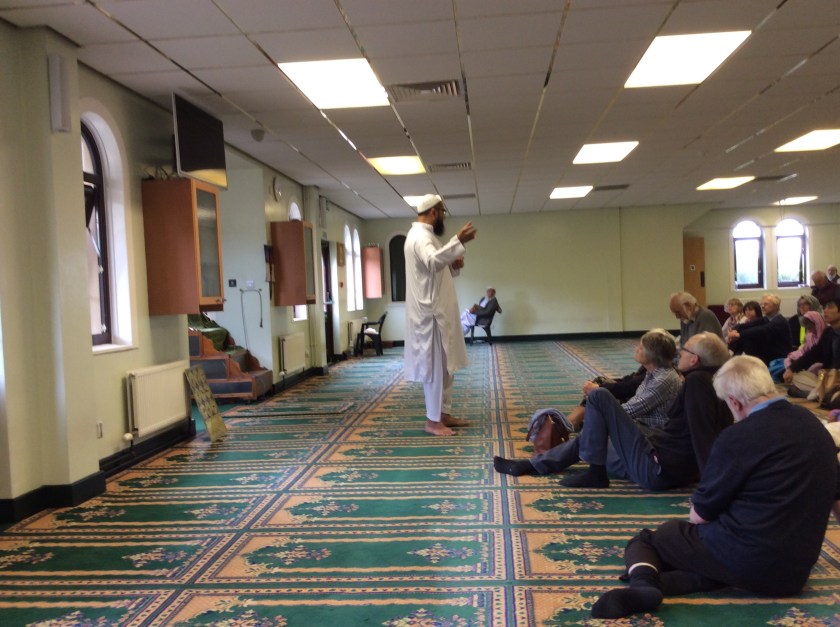
The photograph shows us learning a little about Islam.IMG_0567
Celebrating Eid In Lister Park, Bradford

This afternoon I decided to visit a park here in Bradford which had been a favourite playground in the fifties. Lister Park, also know as Manningham Park, is not far from the city centre and is in an area of Bradford which has been home to Asian families for generations. I realised, as I sauntered through the park, that families were enjoying an afternoon of fun and games. The brightly clothed children and adults led me to wonder if it was Eid and that local families were celebrating the end of the fast.

I sat down on a bench near Cartwright Hall Art Gallery and was immediately approached by a beautifully dressed and smiling woman who asked me haltingly if her husband could take a picture of us. I was so taken aback I said yes, of course. When I asked her why she wanted the photo she said that she respected and loved old people! I found this really touching and wished her blessings for Eid.

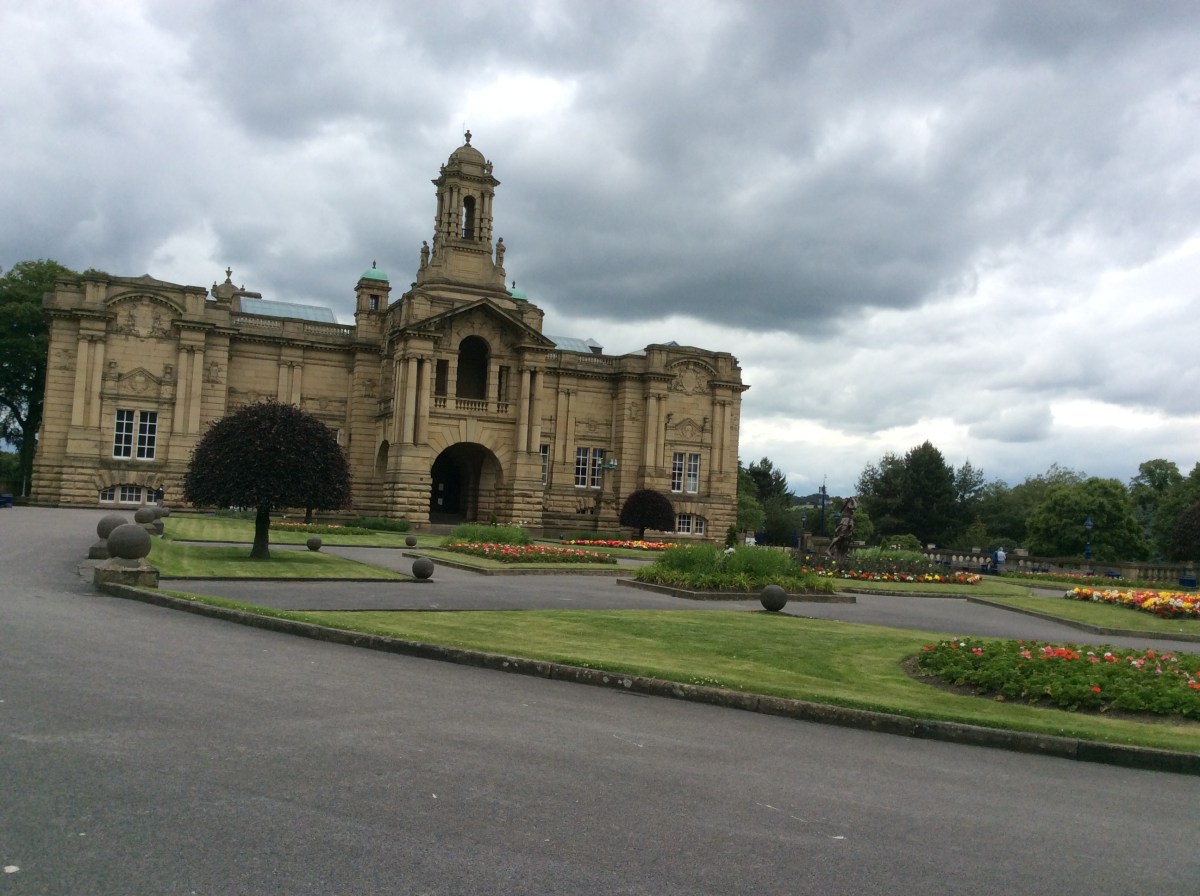
Many things about Lister Park remain the same but near Cartwright Hall there is now the beautiful Mughal Water Gardens. These gardens reflect the cultural mix which is so much a part of Bradford’s heritage. It really is wonderful to see this serene and exotic creation in the midst of a typically English park.   As I was strolling round, admiring the streams, fountains, plants and geometric designs, two young Asian women, also dressed for the festival, greeted me and we had a chat about the gardens, the park and what the park used to be like when I was a child. Unlike my friend earlier, they had broad Yorkshire accents, though their dress was as modest and traditional as hers.

As I left the park more families arrived and the young man in the cafe told me that, as it was Eid, they expected to be very busy later in the afternoon. I always loved Lister Park as a child and many aspects of it fuelled my vivid imagination at a time when it seemed a magical place. It made me happy seeing other children being caught up in that magic.

Reflections on Returning Home

In April I returned to live in Bradford after living in various places over the past fifty years. Since the move I’ve had a chance to reflect on how it feels to be back ‘up North’. It may be fanciful but I really feel that Bradford is happy to have me back. For my part I am discovering that this much maligned, but to me beloved, city has a lot more going for it than many people think.

First, I’m really happy to be living near my family again and getting to know them better. My sister, brother in law and myself have flats in the same sheltered housing scheme and one of my nephews and his family live nearby. My niece and her family live quite near also. The family helped prepare my flat before I arrived.

We live in an area on the western fringes of Bradford called Thornton. Probably its major claim to fame is that it is the birthplace of the Brontes. Their house is now a cafe called Emily’s! Thornton used to be a village outside Bradford and still feels like a village with old houses and steep, uneven streets. A bright sunny day shows off Thornton in all its old fashioned charm but we did have snow one morning in May! We are about six miles from the city centre and, apparently, if you travel out from the city centre in most directions fields and small villages and hamlets appear. On the eastern side this is not the case as it is there where Bradford merges into Leeds.

The bus service during the day and during the week is great but buses are less frequent in the evenings and on Sunday. I love the bus ride into Bradford and I’ve also travelled further afield, Keighley, Shipley, Halifax and even taken the train to York and Leeds. It takes about twenty minutes to get into town and I am still struck by how much the city centre has changed and how much of it is still the same.

Sometimes in the city centre I come across a building or a street which hasn’t changed at all. When this happens memories come flooding back. Not dramatic memories but many small, sometimes poignant, ones. Actually, there is one dramatic memory. Several times a week I pass a run down former cinema and concert venue where I saw the Beatles in the early sixties.


Why I’m Moving To Bradford

WHY I’M GOING BACK TO BRADFORD

I came to Oxford in 2004 to be part of the community and work at St. Francis House. Since the community ended in July of last year I have been thinking about my life in Oxford and wondering if it might not be time to move back to my home town. I came to Oxford to be a part of the Catholic Worker community and have had an exciting, happy and sometimes very painful time here.

I’ve made some wonderful friends and the joy of social media is that I’ll be able to keep in contact. Before giving the reasons for my move I want to honour one aspect of life here which cannot be replicated. This came directly from St Francis House and is, of course, the sandwich distribution which we started eight years ago. I’ll miss the people on the street who have been our ‘guests’. They have always been friendly and grateful for the food and friendship we have shared. I know there are homeless people in Bradford and, who knows, perhaps I’ll get involved in something there, but our friends on the streets of Oxford have been a part of my life here and will always have a place in my heart.

I’ve written before about the band of students who distribute the sandwiches I make each week. Students came on board six years ago and have come and gone but have always been consistent in their generosity. The present group are working out how to carry on with the sandwich run when I’m gone.

The reasons I’m going ‘back to my own ones’ are connected to my age, my disability and my family.

My visual impairment is getting worse and, as Oxford is becoming more and more crowded as the two universities expand, I find it difficult getting around in the narrow streets. I am in real danger of isolating and spending most of my time in my beautiful flat rather than going out. There’s quite simply more space in Bradford, although the streets are just as uneven and very hilly! I was in Bradford last week and had a great time finding out where the Quaker Meeting House is without dodging shoppers and students.

My sister said she was a bit worried about my being in Oxford far away from family and I am happy to be nearer to her and her children and grandchildren. I have a flat in the same sheltered housing scheme as my sister and her husband. It is seven miles from the city centre. Buses are frequent during the day but only one an hour after 8pm. The area is called Thornton and was once a village outside Bradford and still has old buildings and cobbled streets.

I’ll be worshipping with Quakers and hope that the Quaker community will provide openings for the kind of work I’ve been doing for the past twenty years. We’ll see; I’m not going to rush into anything. I trust that God will show me how to be of service.

Seeing With The Heart – visually impaired children in Perm

Last year in Perm I visited the Association for the Blind. This Association is nationwide in Russia and the Perm branch is very active. This year I spent several hours in a school for blind and partially sighted children. This gave me great joy as I attended such a school myself in the 50s and 60s.

The students at this school range in age from 6 to 18. The older ones take national examinations when the time comes and then move on to work or further education. It is at this point that they become involved with the Association for the Blind.

The day of our visit to the school was beautiful; warm, sunny and golden with the autumnal scenery surrounding the building. I was accompanied by Olga, a student of English at PSU and this was her first assignment as an interpreter.

The school is in the suburbs of Perm and is three storeys high. From the outside it seemed quite imposing but once inside we found it light, airy and spacious. A senior teacher welcomed us, gave us tea and told us something about the school. It is over a hundred years old and is one of three such schools in the Perm Region. There are about 150 pupils, some boarders but mainly day pupils. Blind and partially sighted children are educated together.

We visited a gym class first and later on a judo class. Pupils have won various awards for judo and other sports and it was inspiring to see how the partially sighted pupils helped the blind students to participate fully in the lessons.

We spent time looking at art works created by the students and attended an art class. The previous day the class had gone on a nature walk and the teacher was asking them to describe the sounds, smells and feel of the walk, as well as talk about the colours they had seen. They then set about creating a frieze depicting their walk. It was wonderful to see the collaboration. The blind students, assisted by a sighted one, created vivid pictures using coloured plasticine while other pupils used paint to recreate the autumnal landscape.

After lunch we went to a music lesson where a girl was learning piano. We had an interesting conversation about the challenges of reading music with impaired vision. Then we looked at the boarding accommodation and then went to the Miracle Room.

The students themselves gave this special room its name. In it small groups of children rest and relax on huge bean bags, listen to evocative music or a story. The lighting is soft and coloured and the atmosphere was wonderful. While we were there there was a group of six eight year olds, all blind. They had been told we were there and asked to meet us. They came up really close and touched us, offering their hands to be held. One little boy, Maxim, put his arms right round my neck and gave me a big hug. A perceptive little girl wanted to know why we were not speaking Russian to each other. I explained that I lived in England which is why I don’t speak Russian. I don’t think she was too impressed!

Before departing we attended an upper school assembly on the theme of road safety. The theme was presented through music and poetry and afterwards the students went away in groups to work on a quiz on the theme of road safety.

This visit was the highlight of my time in Perm. Olga too found it both moving and inspiring

Throwing in the Towel and Joining Facebook

Last week I decided to join Facebook. I have spent many years resisting this but realised that if I wanted to keep up with news from Afghanistan this was the only way. Afghan friends and our group, Voices For Creative Nonviolence UK, use Facebook rather than email so I threw in the towel and joined up.

So far it has been a rewarding move. There are almost daily reports from Afghanistan and VCNCUK. I feel more connected and up to date. I also receive items from other groups with which I am involved, for example Quaker Asylum and Refugee Network and Friends’ House Moscow (Russian Quakers). News about resistance to war and other justice issues reach me through a small but carefully chosen group of friends who are local and who happen to be on Facebook.

There have been other advantages. First, family members are now in touch and I can be in touch with them. I’ve shed a few tears over some ofthe photos they share and love to see how my three great nieces and three great nephews are growing up.

Another lovely result is the number of people from my past who have been in touch. This has happened because I contacted a small number of people from different stages of my life and through them others got on touch. Some of these are people I knew since they were eleven! They are grown up now with their own families.

Because of my visual impairment I only work on the site on my desktop computer. I can’t imagine what it’s like using a ‘phone! A friend came round recently and explained the finer points of managing the site and also explained the rather strange vocabulary.

This morning I said good bye to a friend who is leaving Oxford. I’m really happy that we’ll be able to keep in touch on that giddy, garish, busy and brightly coloured screen which tests my powers of discernment.

To Russia With Love – Again

I am really excited about returning to Perm this September. Oxford’s Russian twin city is really welcoming, it’s a bit like being in the north of England.

I enjoyed our visit last year but wanted to return as I felt that last year I had to spend a great deal of time coping with being visually impaired in new surroundings. I’ve written in an earlier piece about what it was like being a V.I.P. in Perm and I was certainly looked after.

This year I have offered to give conversation lessons with students at Perm State University, at whose invitation we are visiting. I’m preparing short texts for reading and discussion on The Street Kids’ School in Kabul, run by our friends the Afghan Peace Volunteers; the crisis in Calais and the wider question of asylum seekers, and something about the Arms Fair in London and the various groups opposing it. I could tell them something about Jeremy Corbyn as the election will take place while we’re there.
This year I’ve been learning Russian. It’s fascinating and also difficult. It will be fun trying it out in Russia! I’ve signed up to continue the course in September.

The most important thing about journeys and visits like this is that we, ordinary citizens, get a chance to talk to ordinary Russians. So much of the world’s ills are caused by physical borders and cultural barriers. We can break through both if we are willing.

Dorothy Day and ‘The Duty of Delight

Five years ago I moved into sheltered housing here in Oxford but continued spending time and working at St Francis House until the closure on 30 June. Over the past week or so, in the peace and quiet of this lovely little flat, I’ve been reading Dorothy Day’s diaries (1934-1980) and find them an unexpected companion in this time of change. I’ve had a print copy of the book for a few years but it was only when I found I could get a Kindle copy on my iPad mini that Dorothy’s words and thoughts were unlocked for me; I can no longer read normal print.

I’ve written earlier in this journal of my time as a Catholic Worker, the movement started by Dorothy and Peter Maurin in 1933, and although there is sadness around the closure of SFH, I am really grateful for my time spent in CW communities in Los Angeles, Washington D.C., New York and Oxford. Reading the diaries has brought back memories of my two stints in the U.S., one of three months and one of eighteen months. CW life for me began with reading ‘Loaves and Fishes’ by Dorothy in 1999 and reading ‘The Duty of Delight’ seems a fitting accompaniment to this period of transition.

Instead of reading the book chronologically, I began by reading the entries from 1970 to the end of Dorothy’s life in 1980. At the time of writing I’ve just completed 1934 to 1940. It’s interesting and moving to see how she was aware of the same difficulties, challenges and joys she experienced throughout her life. The entries are really personal and honest and reveal a genuine vulnerability in the life of a woman seen publicly as strong, determined and, at times, uncompromising.

Anyway, this is not a review but merely musings

Dorothy converted to Catholicism in her thirties and Peter Maurin was a great influence on her thinking. I think that from the earliest days of the CW she met, through Peter, many Catholic thinkers and writers who formed her thought, theology, spirituality and reading. She was avid to make up for lost time and she was always a voracious reader. I was amazed to find in her diaries mention of many of the classics of Catholic spirituality which I read during my noviciate. Some of these books really influenced me and I was delighted to find out how much Dorothy appreciated them. It occurs to me that, because Dorothy became a Catholic thirty years before the Second Vatican Council, most of her reading was written by priests and religious. Vatican II stressed the importance of the spirituality of the laity and since the sixties innumerable books of Catholic spirituality and theology have been written by lay people. In a beautiful irony, one of the most influential lay Catholics of the twentieth century IS Dorothy Day and her writings have inspired generations.

Dorothy also read fiction and loved listening to music on the radio. It’s wonderful to read in her diaries about how much she was affected by the classics of European and American literature. She always loved Russian writers and I was interested to learn that while Tolstoy and Dostoevsky were favourites from her youth, she found Chekhov spoke more to her in later life. This has inspired me to read more of his short stories.

It saddens me when peace activists tell me they don’t read fiction. For Dorothy, fiction, classic and modern, deepened her insight into the joys and sufferings of humanity. Me too!

St. Francis House and Beyond

It was the House of Hospitality, St. Francis House, which brought me to Oxford almost eleven years ago. The Oxford Catholic Worker community ran St. Francis House for twenty two years and it has been a joy to share in the work. Now things are changing and Clive and Mena, who own the house and started the work, are taking a different direction and hope that the house will continue to be a resource for the local community. They are wonderful people and all my love and prayers go with them as they embark on this new venture.

We told our guests, five asylum seekers, almost a year ago that the house would be closing. The long closure has been painful but also blessed. We have been reflecting on all the people who have lived at St. Francis House, guests and workers, and there have been so many inspiring people.

It seems a good time for me to put down some thoughts about what this closure has been like for me personally.

For some time now I’ve been aware that the work has been getting too much for me physically. I’m no longer young and my sight is failing. The closure of St Francis House has made me reflect on my life from now on. There are many positives in this, the main one being membership in the Society of Friends and being part of Oxford Quakers. Being a Quaker in Oxford opens up all sorts of opportunities for continuing the kind of work I’ve been doing as a Catholic Worker; resistance to war and warmaking, active work on behalf of marginalised people in Oxford and sharing in a worshipping community.

The last few months leading up to the closure of SFH were painful for me, mainly because of my concern about the guests and their future. I realise that I went through a genuine grieving and mourning period but certain things have contributed to my being able to turn this grief into positive and active joy.

First of all I am able to continue our weekly sandwich distribution to homeless people in the centre of Oxford. This has been part of SFH life for nine years and for five of those years we have been accompanied by a small but enthusiastic group of students. Food and drink preparation now happens at my flat and I feel a real sense of connection with SFH while carrying this out, especially as I’ve brought from SFH my favourite set of scales, my favourite tin for making shortbread and the big yellow teapot!

Secondly, I have been able to offer hospitality to one of our former guests during Ramadan. I was originally prepared to take two guests as I have a guest bed and the bedroom is big enough for two people to share for a short period, but this wasn’t necessary in the end.

There is a project in Oxford now which attempts to find accommodation for asylum seekers in spare rooms. I thought that I might be able to join this scheme by offering emergency accommodation for a couple of weeks. I don’t have a spare room but am happy to give up my bedroom for a short while and sleep in the sitting room. I thought it might be a good plan to ease myself into this and see if it worked, by offering accommodation to our young former guest, N., who had nowhere else to go and was planning to sleep on the streets. It has worked so far. It has been easy because N. and I know each other; it is summer and he is happy to spend time out of doors and seeing friends; observing Ramadan means he is often with his worship community and shares food with them after nightfall; he is on the list to take up accommodation in a spare room when one becomes available. I know it would be very different offering accommodation to a complete stranger but I think I might give it a go!

V.I.P. in Russia

When the possibility of visiting Perm presented itself I thought, as I always do, ‘Will it be possible given that I am severely visually impaired?’ Well, I’m back to tell the tale so here’s how it went.

First of all I booked assistance at the airports in London and Moscow. This worked like a dream. From the moment I arrived at Heathrow I was placed in the care of staff who accompany passengers with disabilities through the airport and into the aeroplane. In Moscow it was the same and I was able to speed through immigration etc in a stress free fashion. The return journey was the same and I have nothing but praise for the staff in both cities who made the journey so much easier.

During the whole visit I had to depend on the help of my companions. In Afghanistan my companions shared out this assistance so that each day a different person took the initiative to help. This worked well in Russia too and sometimes my guide would ask someone else to offer their arm so that they could take photos or spend a bit longer looking at an interesting piece in a museum. I am really grateful for all the help Alison, Sue, Carole, Rico, Chris and John gave me as sometimes the pavements were uneven, and steps and staircases too. Not many buildings we visited were adapted for easy access and I know that people in wheelchairs have a very difficult life. I think there is legislation about accessibility but that comes from central government and the regions are not always able or willing to implement it.

My wonderful hosts, Danil and Olga, were terrific. I really enjoyed staying with them, and their inquisitive cat, in their apartment not far from the University. They are a young couple, he teaches physics and she works in the International Department at the university. They were so kind and considerate and made life simple in the flat. Both of them were happy to give me an arm when we went out and never failed to warn me of hazards in the way. This kindness gave me a lot of confidence.

Karen arranged a visit for me to the Perm Association for the Visually Impaired and Hearing Impaired. The Director is himself a V.I.P and the visit was most interesting as I learnt about the history of the association and the work they do. They gave me a wonderful DVD, made in 2013, which, although I don’t understand the speakers, gives an inspirational and comprehensive picture of the lives, challenges and accomplishments of V.I.P.s in the Perm Region. The film looks at all age groups, work and leisure and has several interviews with V.I.Ps. I’m going to ask a Russian speaking friend to watch the film with me to translate, although as I am learning Russian it’s good for me to watch alone to see if I can pick up the gist of the speakers.

Watching this documentary about V.I.P.s in Perm makes me realise that my visit to them only scratched the surface of what they do and I really want to return to learn more.