A Visit To The North Of Ireland

A Visit To The North Of Ireland – A Personal, Subjective Reflection
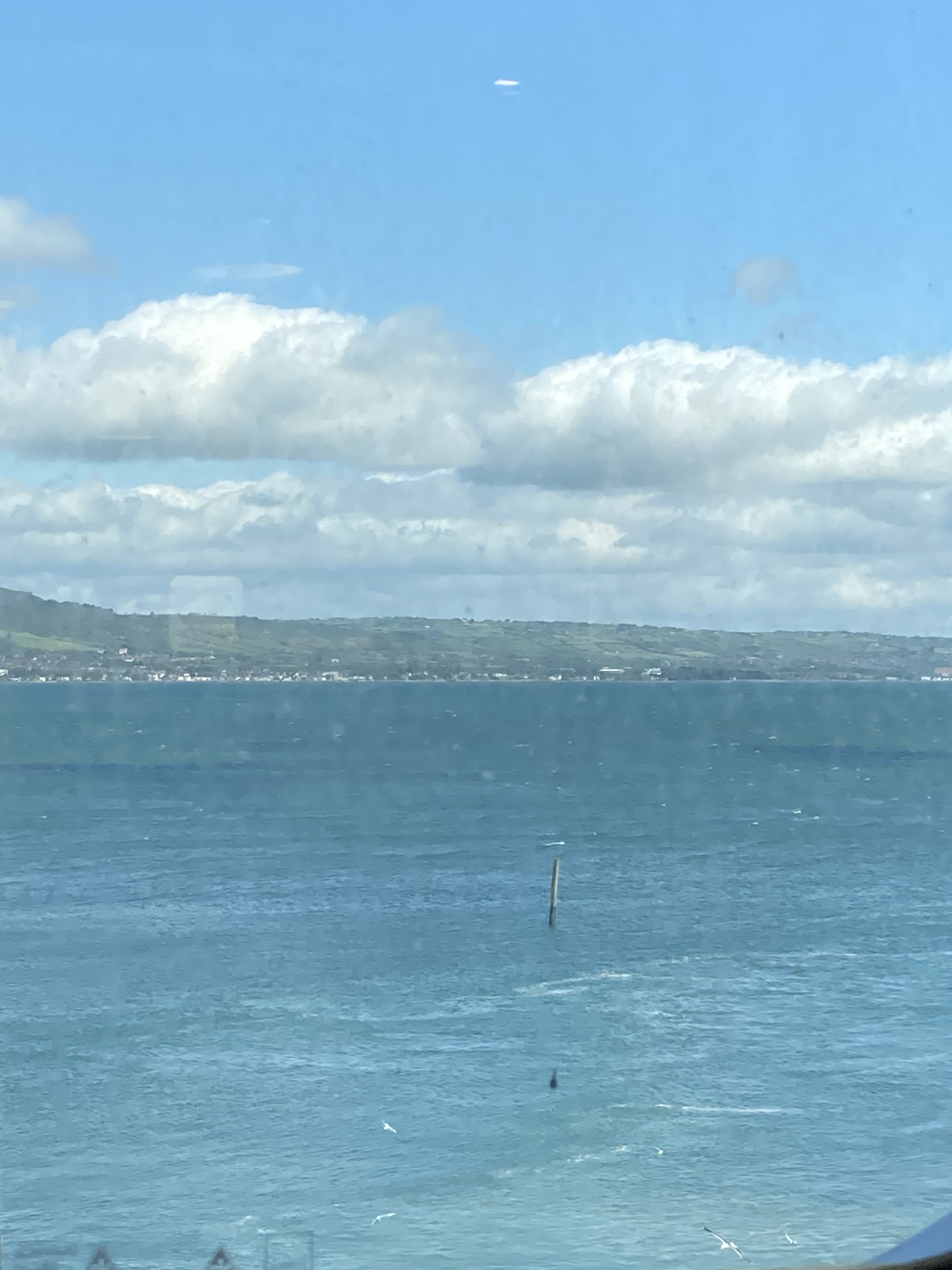
From the ferry

From the 20th to the 26th of May I accompanied a group of students and staff from the Peace Studies and International Development department at Bradford University, on a study visit to the north of Ireland. I have made the decision to call it the north of Ireland rather than Northern Ireland for various reasons which may become obvious as I write. Or not…

Our journey began when we took coach and ferry to Belfast. I really appreciated the companionship of everyone and the friendship and solidarity I experienced helped to make this a memorable journey and visit.  I particularly appreciated that everyone showed kindness and sensitivity towards me taking into account my age and disability.

After our pleasant, rather long but uneventful journey, we arrived in Belfast on Friday, 20th May. On our way over we met three elderly Scottish chaps from  Helensburgh who were going on a trip to visit the Orange Museum! Although drink had been taken by then – not by us – we had a congenial chat.

Saturday was a really eventful day. In the morning we were taken on a tour of Belfast by the Black Cab Tours. The taxi drivers were the guides and we got a guided tour which was, in our taxi at least, entirely from the Republican Catholic side. 

After this we went to the Irish Republican History Museum which had been set up by a woman called Eileen Hickey.  She had been an IRA prisoner in Amargh gaol. Her sister, Susan, was one of the guides and it was a really impressive collection of Irish Republican history, carefully and lovingly curated by Eileen and now run by volunteers 

After lunch we went to meet our afternoon guides. 

The large group was split into two – twelve in each group. Our group started on the Falls Road, at the Divis Tower where we met guide, Danny, who had been an IRA prisoner. He took us the length of the Falls Road and pointed out notable murals on the so-called peace walls. I was shocked and saddened to learn that parts of Belfast are still segregated and that there are gates in the walls which are closed at 7pm every evening to prevent marauding youngsters from going into the opposite side. 

For me the most moving moment was standing in front of a mural of hunger striker, Bobby Sands, the usual smiling, typical 1970s image which is familiar to us all.

“never, never, never

will a

martyr die,

He’ll smile upon us long from mural’s wall”

(Padraig O Tuama,  ‘h u n g e r  s t r i k e r s)
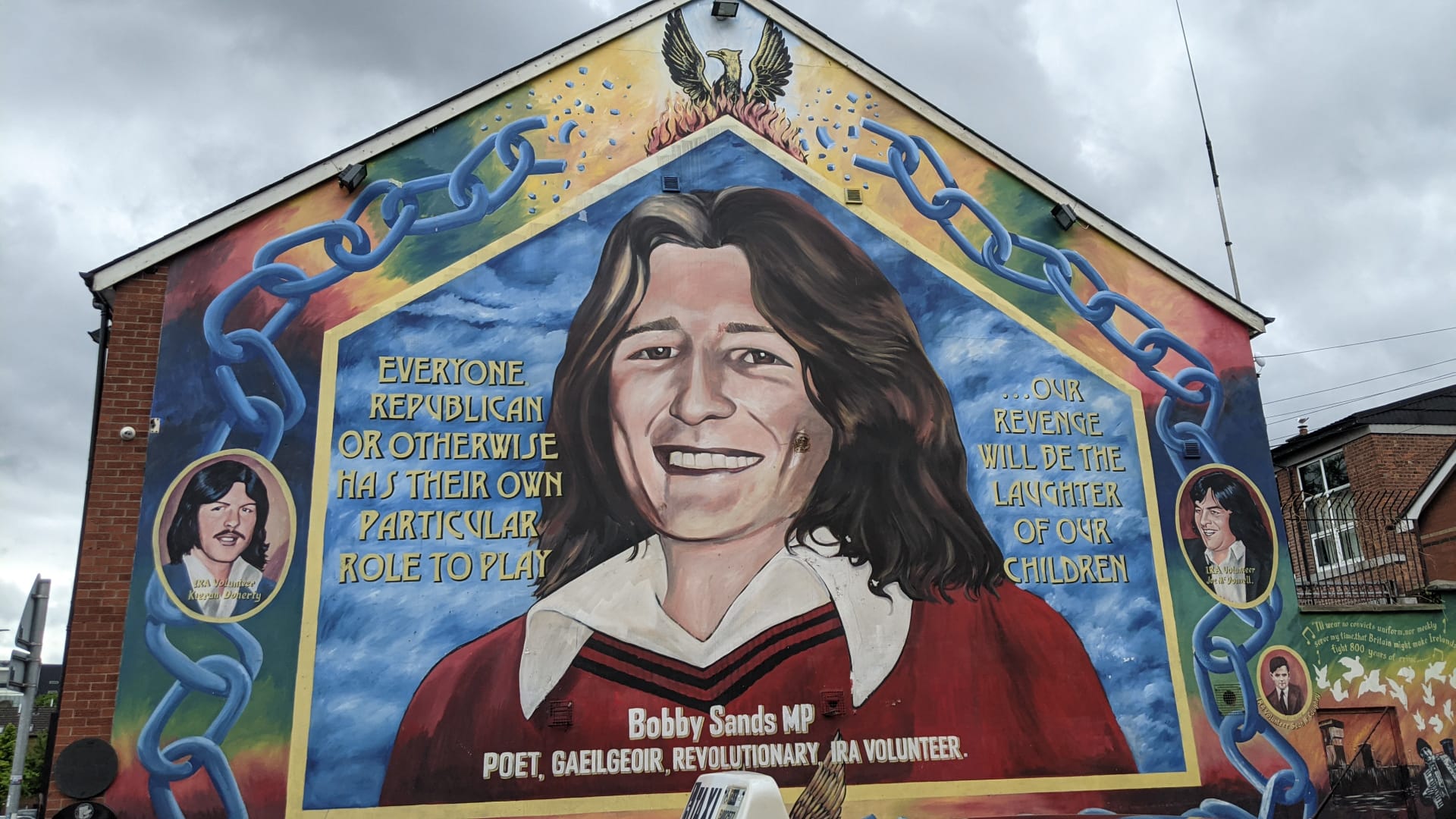
 So many memories came flooding back to me of times in the 70s and 80s when I was involved with Irish friends in England and campaigning against British injustice to the people of Ireland. I never campaigned for Bobby, though, I was too wrapped up in my own petty worries in 1981 but reading “Ten Men Dead” a couple of years later really moved me to, as Daniel Berrigan says, outraged love.

Danny, who was a vivid narrator, took us to a point where we met our next guide who was going to take us down the Shankill Road. Mark had been a former soldier but he never told us that – we heard it from others. What came across to me and the others was that the Loyalist, Unionist community feels very isolated and betrayed, most of all by Britain whom they have defended so fiercely.

My feeling, and it is only my opinion, is that the Republican side have always had a great deal of support from the rest of the world because they are seen as freedom fighters and indeed they were. The Unionists have been completely on their own because not even people in Britain understand them.  I could be mistaken here and as I said, it is only my opinion. 

Standing before a mural of the UVF and listening to Mark, we were joined by a friend of his called Robert. Things went rather strange from that point on. Mark did as goodbye and said that Robert would finish our tour with us. Things became a bit difficult from then on as it wasn’t as easy to ask him questions as we had done with Mark, who was an accredited guide. We were all really tired but we did patiently accompany Robert for the next half hour or so, listening to him and feeling his anger and pain.  

We were running late by then as we had a meeting in the Irish Republicans Felons’ Club.  Our taxi driver was highly amused that we had called a taxi to the Shankill Road to be taken to the Felons’ Club on the Falls Road!  We were probably lucky he had a sense of humour.

We ended our day in the club in conversation with a researcher in peace and reconciliation who has also worked with the Corrymeela community. It was a good, reflective and gentle ending to an emotional, heart rending and at times deeply disturbing day.

Sunday  was a free day and Ute Kelly and I went to Catholic mass and then to a service at the Protestant cathedral. We had a restful afternoon and then a couple of hours reflecting on what we had seen and heard over the past couple of days. 

Now, I think this next event happened on Sunday evening. Several students, the three staff members – Fiona, Ute and Collins – and myself went for an evening meal at a middle eastern restaurant. It was very tiny and we were taken to a gazebo type structure which seated the overflow. There was a family in there already and they greeted us in a friendly manner. Because we was such an international group of people one of the women asked us where we were from and what we were doing in Belfast. Fiona explained who we were and then the woman told us she was Giuseppe Conlon’s granddaughter and Gerard Conlon’s niece. Imagine our delight at meeting Sarah. Fiona and I knew exactly who she was and after she and her family had left we explained to the rest why we had got so excited. Fortunately we were able to tell the students that the full story of the Conlons, father and son, is told in the film “In the Name of the Father”.

Monday was quite an academic day as we went to the University of Ulster to hear speakers there talking about the elections and about divisions in the community. In the afternoon we had three more presentations. I found the presentation of the research done in Enniskillen very interesting and also we were introduced to the reaction in the north of Ireland to the British government’s rushed legislation on the Independent Reconciliation and Trust Recovery Commission which is perceived as a cover-up of activities by the military, police and security services and the use of informers during the conflict.

In the evening Fiona- our intrepid and tireless leader, Ute, a couple of students and myself went to a poetry reading.  One of the poets reading their work was Padraig O Tuama whose work I have started to read, thanks to being introduced to his poetry by Ute 

Our visit to Derry on Tuesday was as intensive as our Saturday tours.

Our first stop was at the Museum of Free Derry which began with a presentation by a history researcher and then a visit to the museum. I didn’t go on the visit but I was very fortunate that the young historian who had spoken to us put the museums app on my iPhone.  The app has audio description and is a very valuable historical resource.

Before lunch we went into the centre of Derry to attend a demonstration against the IRTRC.  Demonstration was in support of victims killed during the conflict whose killers have never been found or have been protected by the British authorities. Since returning home I have done a lot of reading about such cases and have been appalledI  what I have learnt through my reading and watching of documentaries.

In the afternoon we had a tour of the Bogside, focusing on the events of Bloody Sunday and then we met Paul O’Connor, director of the Pat Finucane Centre.  Pat Finucane was a human rights lawyer who was assassinated by Loyalists in Belfast in 1989.  In his short career he brought several successful cases against the British government.  The centre carries on his work and has done a tremendous amount of research on cases of disappeared people and murder victims during the conflict. From Paul we heard more about the protest which we had seen in the centre of Derry earlier. We were all moved by his presentation of what is a serious and deeply wounding situation not helped by the attitude and behaviour of the British government. I’ll come back to this at the end of this piece.

We returned to Belfast on Wednesday morning and had a visit to Stormont where we were shown round by the education officer. We also met an Ulster Unionist MLA who had been leader of his party, Mike Nesbitt. His presentation and his answers to questions seemed very reasonable to us but our chatty taxi driver who took us back to the city centre laughed and said politicians will tell you anything they think you want to hear!

In the afternoon we had two more presentations from local academics. I know I haven’t done justice to the input of academics on this visit and I am aware of my failure in this regard. 

However our very last presentation was by a former British soldier, Lee Lavis, who is a member of the wonderful Veterans for Peace. He has also become an academic quite late in life, I think he’s doing a doctorate in history.  He was a very good speaker and we were all deeply touched by his presentation. It was a very good ending to what had been an exhausting but exhilarating study visit to the north of Ireland.

We returned to Bradford the next day. 

The Aftermath

Due to the fact that I joined the group quite late in the day, I didn’t do a lot of preparation for this visit even though the staff sent out a comprehensive list of materials to look at beforehand.  I did watch some documentaries giving background to the history of Ireland and, thanks to Ute, was introduced to the poetry and theological reflection of Padraig O Tuama.  I personally took for companionship Seamus Heaney’s poetry and the music of Van Morrison, Christy Moore and Mary Black.

I was quite ill when we got back for about ten days. Although I felt wiped out I was able to spend my time in continuing watching documentaries and reading, as an audiobook, a powerful account of the 30 years conflict known as the troubles. This book is called ”Say Nothing”, by Patrick Radden Keefe.  It put into context for me all that we had heard from Paul O’Connor in Derry. The documentaries I watched also covered the same ground. I am still wondering, as a peace activist and campaigner, what I can do as a British citizen to help highlight the injustice with which the British government is even today, treating the people of Ireland. 

I’m going to continue exploring the poetry and theology  of Padraig o Tuama; revisit the poetry of Seamus Heaney and sooth my spirit with the voices of Van Morrison, Mary Black and Christy Moore

I am old and I feel my strength very slowly diminishing but I am really grateful at this visit to the north of Ireland has stirred in me outraged love.
Whiteness and Racial Justice Learning-Where Am I Led?

Our five week sessions, run by Turning The Tide  on “Whiteness and Racial Justice Learning For Quakers” is drawing to a close.  However, the work does not close.    I have seen these learning sessions as a journey through a dense forest with a winding path leading to who knows where.  The five sessions and the resources offered each week are a compass to keep me going in the right direction and on the right path.  O.K., that’s the end of that metaphor!

I am asking myself three questions. 

“What have I learnt?”  “How have I learnt?”  “Where do I go from here?”

I have learnt that my whiteness is an unearned privilege which has influenced every part of my life, past and present.    I also now know that this privilege has come at a cost for people of colour.  I have learnt that although I celebrate the US civil rights movement and its remarkable leaders, I need to look closer to home for stories of racial injustice in Britain and the corrupt colonial history behind it.  While not ignoring the American experience and the work done there by a variety of thinkers, I need to learn from the stories of people of colour in my own society and the writers and commentators of colour who will guide my learning.

I have also learnt that this work of interrupting racism is a lifelong work, now that I know I’m complicit.   It is work I need to do on a personal level and with others.

It seems to me that racism is like an addiction; it can only be cured if it is acknowledged and accepted as something which needs to be changed.  A thought I have had recently is that the 12 Steps could be a useful framework for looking at racism but this thought needs a lot of time and space to germinate. 

“ How have I learnt?”  To answer this I go back to ministry I heard on Facebook from a pastor at New Garden Friends’ Meeting in Greensboro, North Carolina.  She made some really practical suggestions as to what we as white people can do at this moment in time to interrupt racism.  One thing she suggested was to research, read, watch and listen in order to learn about the roots of racism and white supremacy.   I looked up books I could read and bought three or four as ebooks and audiobooks.  At the same time I signed up for the Quaker sessions we are just completing. 

While doing the learning tasks set by the Turning The Tide tutor, Lyndsay Burtonshaw , I carried on with my own reading of the books I had bought.  I believe I was led to read the books in the following order:

Why I’m No Longer Talking To White People About Race – Reni Eddo- Lodge

Natives-Race and Class in the Ruins of Empire – Akala

White Fragility – Robin DiAngelo 

Black and British: A Forgotten History – David Olusoga

I have also used YouTube and BBC IPlayer extensively to watch presentations and interviews by these writers.  I’m not going to put any links here, mainly because I do not yet know how and because I think it is more fun to seek out for ousels what we need to know.

I find as I read I am led to other writers and themes and so I have discovered Bayard Rustin, Andre Lorde and Zetta Elliot.

I have just started to listen to a series of Audible podcasts called “We Need to Talk About the British Empire”. 

I learn by stories and storytellers and these podcasts look to be full of stories and personal experiences as well as historical analysis.  The most valuable resources in our five week sessions have been those telling stories, especially stories of people of colour in Britain.

Where will this learning lead me?  This is perhaps the most important question.

In my life I have lived in community with people from different countries, mainly people seeking asylum.  In Bradford I am still connected to women and men seeking asylum through my volunteer work as a Mckenzie Friend.  I resolve to redouble my efforts in this work and also to support organisations working on asylum and refugee issues, by donation and by writing letters and signing petitions.

I can keep alert so that if any opportunity arises where I can interrupt racism I’ll take it.  

Lockdown makes contact difficult at the moment but I can keep vigilant about my own beloved city and the issues affecting my sisters and brothers of colour.  I can work with friends on this and ask for help in finding out what I can do. 

With other Quakers in my local area I can work on these issues and on the thorny issue of why British Quakers are facing the challenge of being more inclusive.

This, that is everything I have written in this piece, is a work in progress… 

Because I Am White…

My home town, Bradford

I felt inspired this week to make a list of all the advantages I have enjoyed because of my unearned white privilege.  This list is not exhaustive and I need to be open to adding things to it.

Here it is so far.

I have never been afraid of being attacked, physically or verbally, for being white.

I was never bullied as a child for being white.

I have never had to think twice before going to certain areas of a city because of the colour of my skin.

Because I am part of the dominant culture in Britain I can always get the food I like and I can always be understood when speaking English.

Because I am British and white I’ve had a passsport since 1971 with no problems of renewal.

Because I am British and white I’ve never been refused a visa and have travelled to Cameroon, Madagascar, Afghanistan, the USA and Russia with no problem.

I’ve been given preferential treatment in all the countries I have visited because of my white skinI’ve never felt fear of attack when in an all black area, for example in Washington DC and LA, because of the colour of my skin.

I never questioned the whiteness of my culture, e.g. in  literature, music, art.  God forgive me but I still have to make myself leave my European centric cultural taste and branch out.I have never been afraid of the police and always felt safe around them because I am white.Even when arrested I have never feared harm at the hands of the police because I am white.

In prison I was treated with care by the other prisoners because i am white – and old and disabled too, possibly.

 In Cameroon, Madagascar and Afghanistan, because I was white  I was protected by physical boundaries, the walls of the compounds, secure doors and windows and by local people who  watched over us and guarded us through the night.

In Afghanistan the Afghan Peace Volunteers were in heightened danger because of our presence, because we wee white.

Even though I was born and brought up in what has been a city on the decline for most of my life, I still enjoy more privilege than many of my fellow citizens whose origins are in the former empire.

Learning Journey Through Whiteness and Racial Justice – 2

We have been given an extensive and varied task list for our second session on “Whiteness and Racial Justice Learning For Quakers”

As usual – it is a Quaker course after all – there is a lot of reading of text. Sometimes, when I have gone to the trouble of reformatting texts so that I can read them, I don’t always find them helpful.  I am not interested in theory but in stories and practicalities.

However, for this piece I’m going to focus on three videos and the three Required Reflective  Tasks we were offered.

The short videos included a song, a story and solidarity.  The song, from Facebook, is from the Douglas family and I think it is called “Stand Up”.  Shots of brutality against black people illustrate the song and it is a good opening to the two videos which follow.

The first news story videos tells the story of a young black boy, Gerard, caught up in racial violence and cruelly attacked by right wing extremists on his first BLM protest in London.  He found little help from the police at first and one overwhelming feeling which comes from his story is his total isolation in this frightening incident.  He is still physically and mentally scarred by the experience and his mother spoke from her heart when she said, “George Floyd is right here in Britain.”  She also wondered if Gerard would have got the help he needed had he been white.

The other news story video was about a BLM protest in Yeovil.  It was a short film but powerful as it focused on two girls from mixed race families who spoke in public about their lives.  One girl said; “Be mindful, be kind; you do not know the history which lies behind the eyes of my black dad.”

Our required reflection tasks demanded time and commitment.  Fortunately I have lots of time at the moment so I used it well.

First, we were asked to research the life of Bayard Rustin.  I watched a Youtube clip but what really helped was a 45 minute talk which i bought from Audible called “We Are One”.  Through this I got a vivid picture of Rustin’s life, work and dynamic character, as well as the homophobia which attempted to marginalise him.  This is a work in progress for me as I have a couple of other books about and by Bayard Rustin

Secondly, we were asked to research Grenfell Tower.  I found two documentaries on Youtube, one Sky news and the other BBC Newsnight.  Both films had a lot of personal stories of survivors and relatives of victims and a great deal about the scandal of the dangerously inadequate construction of the building.  Not only that, the films stressed that the residents had persistently complained about the inadequate fire prevention provision, among other concerns, and had been persistently ignored by the local authority.

What also stuck me was that the Tower was a real community where people were genuine neighbours.  Many residents were poor and black but there was a real international feel to the community as well.

Our final but for me the most moving task was called “Say Their Names”.  We were given fourteen names of people who had died as a result of structural racism.  We were asked to learn their stories and in a worshipful way call them to mind and hold them in the Light.

I created a document on my iPad with names and places and dates of death.  I use this for prayer, a bit like an icon.

Sadly, after the session yesterday, I have added three more names of women whose deaths were shrouded in structural racism; Shukri Abdi, Nicola Smallman and Bibae Henry.  

So far, nothing changes but…!

Final draft of Tenx9 Story

One hot steamy morning in Washington DCin 2003 I went with my young friend Liz to visit our friend, Gary, in DC gaol.

Liz and I were living in the CW community in DC and Gary was a member of Jonah House in Baltimore.  Both communities were, and still are, dedicated to serving the poor in the neighbourhood by providing shelter and food and taking part in nonviolent direct action against all forms of war and war making.  At that time all community members in both communities were white.  The people we served were either African American or Latino with a small number of white Vietnam war veterans.  Both our community, in the Petworth area of DC, and Gary’s, in West Baltimore, were in predominantly poor Black neighbourhoods of our respective cities.

Gary, originally from Madison Wisconsin had been found guilty and sent to jail for a nonviolent protest at the Pentagon.  I can’t remember the length of his sentence but he was in DC so Liz, originally from the Virginia suburbs of DC, and I set off to visit him.

The forbidding building of the jail loomed ahead as we took our places in a long queue of African American and Latino visitors, mainly women and children, some babes in arms.  We had been warned that visiting was a long process so we were prepared to wait.  

The queue moved at a snail’s pace so imagine our surprise and acute embarrassment when an official came up ti Liz and myself and escorted us to the front of the queue.  There was one grumbling in the queue but not much.

They checked our ID and processed us.  Ther was a brief delay when the guy questioned whether my passport was valid ID in the US.  So much for the request in the front of the passport from Her Brittanic Majesty’s Secretary of State requiring I be allowed to pass freely without let or hindrance – but I digress.

Liz and i were led to thee visiting room.  We sat in front of a glass screen and Gary was brought in  on the other side  We had to speak via telephone with him.  Honestly, it felt like being in a film except it was our friend who was incarcerated and sitting on the other side of a glass screen.

Gary was pleased to see us and we exchanged news, then Liz and I had to leave.

It had been an hour since we had been taken to the front of the queue and as we descended the shabby stairs we met the women who had been near us in the queue.  They greeted us with cheery smiles and asked if we’d had a good visit as we passed.

Outside the sun was blazing and the air humid.  The visiting queue was even longer and Liz and I , lost in thought, made our way across the car park, heading back to Petworth and home

“Privilege” – A story For Tenx9

This is a story I have written for the storytelling group I belong to, Tenx9.  We meet every month and have a different topic.  Nine people have ten minutes to tell a true story from their lives inspired by the topic.  Since going online we are advised to write our stories and, although I usually just tell mine, I have found the discipline of writing it really helpful to me.

Our topic for this month is “Privilege”  and apparently many people have offered a story.  I do usuallly tell a story so I don’t mind if this month I don’t share. ‘Tis topic is timely and challenging for me on so many levels.

I usually dictate my story on to the iPad and then tidy it up a bit, making sure I don’t over run the allotted ten minutes.  Once I’ve posted this I’ll pare down the story for telling on Friday to keep to the time.

So, here goes.

I’ve been challenged over the last few weeks about my whiteness, my white privilege, white supremacy and how I behave. I don’t mean I’ve been challenged by people but by events.

A few of my friends and I doing a course organised by Quakers called “Black Lives Matter: Whiteness and Racial Justice Learning  for Quakers” That will be the last mention of Quakers because what I am learning and what I want to write about is my personal experience of my white privilege.

I’m on a real learning journey, I’m only at the beginning of the journey and have absolutely no idea where it’s going to lead. So what I’m offering here is the first step for me on the road less travelled.

To me, my most obvious  examples of my white privilege are when I’ve been abroad. Just to summarise quickly, I spent two weeks in Cameroon and six months in Madagascar where I was teaching English. Although in Cameroon the children called “Long Nose” out after white people, it was affectionate and not malicious. In Madagascar there is a word which means “white foreigner”, “vazaha”  This was a little more problematic but very good for me because I was identified solely by the colour of my skin. I even heard other sisters in the community refer to me as “La Soeure Vazaha”Again no prejudice or persecution was there but it did give me pause for thought.

Returning from Afghanistan my three friends and I were at the airport in Turkey, at a desk asking for help, Two African men came up also needing help to find their flight, like ourselves. We noticed with acute embarrassment how the officials behind the desk  treated us with respect and the African men discourteously.

I think these examples are quite simple for me to understand but now I’m going to talk about my time in the United States. 

I was living and working in communities which worked with vulnerable people, giving hospitality to those in most need and sharing food on the street. The communities I worked with were in Los Angeles, Washington DC, New York and Baltimore.

Nearly every community member, no matter which city, was white. Many of them had lived in those communities for decades and I am in great admiration at their commitment and fidelity but now when I think about it those communities were places of white privilege. We couldn’t have joined those communities if we didn’t have a load of security behind us.  One example for me is the fact that I have had a British passport for forty years which means i can travel nearly everywhere without let or hindrance and have never been refused a visa.  Hence I was able t spend two years in the States with no problems.  (Actually, there were one or two problems but that was because I got arrested several times and that’s another story!)

In Los Angeles and in Washington DC most of the people who received our food and our hospitality were either African-American or Latino. In many ways I was naive, I did ask myself why are some people so disadvantaged and others privileged including myself, but I never really connected that with race.

Two examples, one of my time in Washington DC and the other of my time in Baltimore stand out for me.

As well as giving hospitality the communities I  belonged to, Catholic Worker communities, did a lot of non-violent direct action and one of our friends was in DC jail. Myself and a young member of the DC community, Liz went to visit him.  We joined a very long queue of visitors waiting to be admitted. Imagine our embarrassment when a guard came up to us to take us to the front of the queue. Everybody else in that queue was African-American or Latino. To be fair, perhaps if we had both been young it might not have happened and of course I did have my white cane. They insisted that we be processed quickly and taken up to visit our friend, Gary. After our visit as we left the visiting room and went down the stairs, we passed several people who had been in the queue waiting with us. Many of them greeted us in a really friendly fashion and asked us if we’d had a good visit.

My second example is from Baltimore, West Baltimore to be exact, made famous by the TV series “The Wire” The community, Jonah House, was again  all white and again people who had given their lives to the service of others.  They still do.

Each week food was collected are donated and we made up food parcels. On a  designated afternoon people from the neighbourhood came to collect their parcels. All of them were African-American. The community members always greeted their neighbours with graciousness and friendliness and that particular kind of old fashioned courtesy so typical of Americans of a certain age. It was a warm autumn afternoon and we stood in the yard with our parcels handing  them to people as they arrived. We had the radio on and there happened to be that afternoon a programme about the civil rights movement and the music it inspired. Having this in the background, reflecting on what had been achieved  in the civil rights movement and yet being confronted for several hours by poor African-American neighbours in need of food and other products, is an experience I shall never forget.

Over a hundred years after the abolition of slavery, decades after the civil rights movement, it was still white people giving from their abundance and the poor African Americans receiving. 

As I say, I do not know what to make of these experiences, It will take time for the injustice of my white privilege to sink deep within me and for me to discern what to do about it. Also I am very aware that this journey is taking place in my own country and it is in the British context of injustice to our black brothers and sisters that I’ll need to work.  I trust God will show me what I’m meant to do.i

A Learning Journey Through Whiteness and Racial Juctice

I’m hoping to have the commitment and resilience to write over the next few weeks about my learning from the online course “Black Lives Matter: Whiteness and Racial Justice Learning For Quakers.”  I am not going to write about the sessions, just what I have learnt and am learning about my own white privilege and my commitment to racial justice.

The course willl run for five weeks and we’ll be given reading and watching tasks each week.  These, together with some reading I’ve been doing recently, will form the basis of these reflections on my learning journey.

We had a pre session questionnaire to help us position ourselves and find out about our knowledge and ignorance.  One of the questions was about the beliefs of the Black Lives Matter movement.  I visited the website of the global BLM movement and was profoundly moved by the statement ‘What We Believe’.  Here are some highlights which caught my attention.

The movement aims to build local power and to intervene where acts of violence are carried out by the state or vigilantes.

BLM aims to build a world free of anti Blackness where all thrive, and to unite Black people globallly.

The movement is committed to “healing ourselves and each other” and creating allies.

Finally, my favourite:

“We intentionally build and nurture a beloved community that is bonded together through a beautiful struggle that is restorative, not depleting.”

  The whole document is invaluable as a resource for a summary of BLMs inspiration and impetus.  I did learn a lot about BLM from the website.

Before even knowing about the Quaker course I had started to read recommended books.  Two in particular grasped my attention.  They are;

“Why I’m No Longer Talking To White People About Race”, Reni Eddo-Lodge, and “Natives: Race and Class in the Ruins of Empire”, Akala.

I have both books on audio, both read by the authors.  Listening to these young, passionate voices really adds, for me, an urgency to discover inside myself resources to act in the most fruitful way for racial justice.  I also have kindle versions of the books so I can easily go back to check references or read again the most challlenging parts.  I am aware that i need to do deep rooted checking of my cultural assumptions and my behaviour.

There was a non essential part to the pre session tasks.  I watched two films from the list. I chose them at random: “The Hard Stop” and “Generation Revolution”. they are both documentaries.

The first is about the shooting of Mark Duggan in Tottenham in 2011.  The film follows the campaign for justice and for police accountability.  However, the film’s main focus is on following the lives of two of Mark’s friends, Marcus and Kurtis in the daily struggle of being young and Black in Britain.  Their lives seemed to be caged in by so many barriers.  I felt drawn into their stories to the extent that I was calling out words of encouragement to them as their stories unfolded.

The second film is about a group of young Black activists in South London.  I was trying to imagine conversations between them and Marcus and Kurtis.  The different characters and motivations of the young activists came across strongly and again I felt drawn into their stories.

There is much for me to learn, much to do and much to undo.   It’s an important journey which, as we are in it for the long haul, needs to be “restorative and not depleting”

PhotButo by Anton AtanasoA Restorative and Not depletv on Pexels.com

But what is round the next bend…?A

Slow Down Reading

I’m reading  a variety of books during this time of slow down.  I’m no longer keen on the term ‘lock down’ and prefer ‘calm down’, but ‘slow down’ reflects my life and mood best of all at this time.  ‘Lock down’ was imposed on us, ‘calm down’ was how some of us treated the imposition, but ‘slow down’ for me is a really positive and affirming action.  I have no intention in the immediate future to change how I am living which is in a leisurely yet focused way.

So, back to the reading.

One major element in my choice of reading lately has been the Black Lives Matter movement and the challenge to look at white supremacy, white privilege and how they influence my life, thought and behaviour.  

I have just finished an initial reading of ‘Why I’m No Longer Talking To White People About Race’ by Reni Eddo-Lodge.  I have it as an audiobook and kindle book.  Eddo -Lodge reads the audiobook herself and this really adds to its impact.  I felt myself so challlenged at things she says that I already know which passages I’ll be returning to for deeper reflection and examination.

Another book I am using on the same theme is  ‘Me And White Supremacy’ by Laylaf Saad.  this is more of a work book with questions for self examination but she sets out the issues to be examined clearly before presenting the questions.

As a great lover of fiction I am changing my usual reading habits and choosing books by Black writers.  At the moment it is a classic American novel, ‘Their Eyes Were Watching God’ by Zora Neale Hurston.  i invariably read fiction these days via audiobooks and the narrator of this book is wonderful, her name is Ruby Dee.  The novel tells a dramatic story and has a strong main character, Janet.  However, what really moves me is the poetic and descriptive  language.

I am in a book group with other local Quakers.  We came together because we are part of the local  Roots of Resistance group, a national Quaker group set up last year to resist the Arms Fair in London last September.  Our book group is reading ‘Doughnut Economics’ by Kate Raworth.  Again i have the audiobook and the kindle.  I need to read print for nonfiction in order to take it in but the audiobook is a good supplement to print.    The author again reads the audiobook and it is fascinating.

For light relief I’m rereading Frances Brody’s series about a woman private investigator in 1920s Leeds, Kate Shackleton, a young war widow. 

STOP PRESS

I’ve just registered on an online course called ‘Black Lives Matter, Whiteness and Racial Justice Learning For Quakers’.  Looking at the reading list and tasks set, my reading for the next five weeks willl be pretty much set!

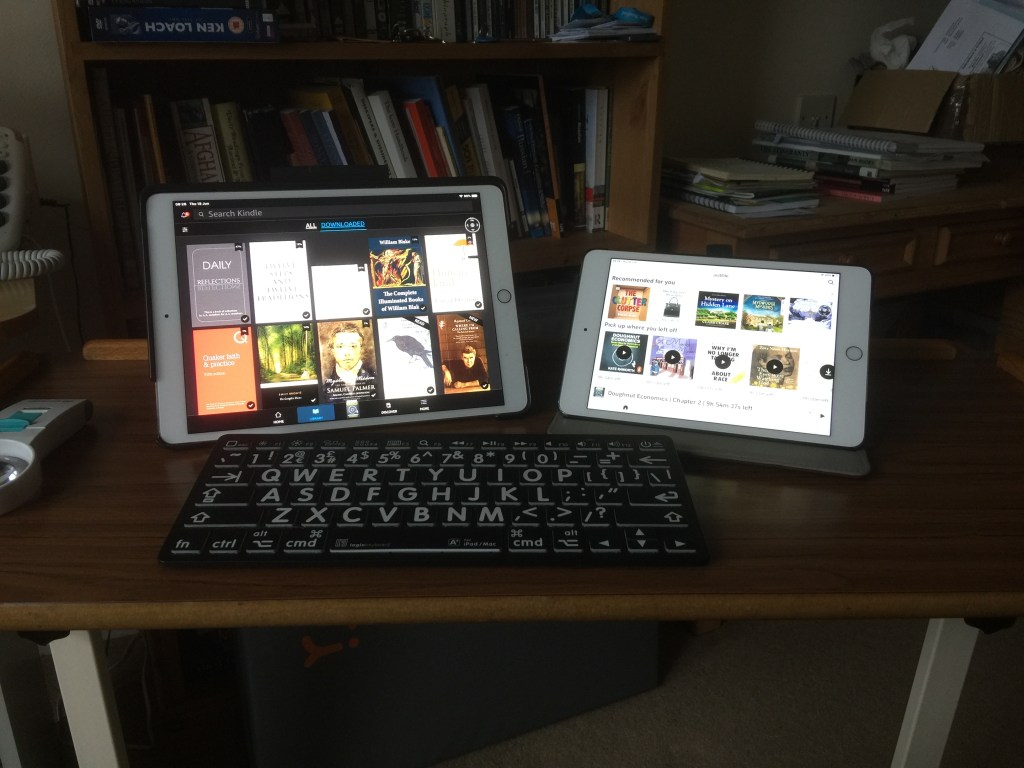
Some books in my kindle library and audible library

Where There’s A Well There’s A Way- John 4:1-42

One of the great things about this lockdown for those of us who are retired, is having time to pursue interests.  At the moment I am doing a short course on Bible Study For Quakers, run by Woodbrooke, the Quaker learning centre in Birmingham.  I was delighted to see this course offered as one thing I miss since becoming a Quaker is regular scripture sharing with others.  Being of the generation of Catholics who embraced Vatican II which, among many other innovations, encouraged us to read, study and act on  scripture, I embarked on this course with optimism.  We are looking at three books in particular; John, Ephesians and Revelation.   Here is a reflection I wrote on John 4:1-42 – The Woman at the Well 

I have always found the gospel according to John quite inaccessible. I am much more at home with Jesus in Luke, or even Mark although Mark’s Jesus is often grumpy and unreasonable. However, this story, John 4:1-42, is one of my favourites in the whole of scripture. 

I have really enjoyed returning and letting it sink in over the past few days and once again feel I know this unnamed woman. As a story it has character, movement and depth and as a text with spiritual meaning it can be pondered over and over again. I have often, over the years, used this text for imaginative meditation and have found it to be rich in meaning.

This story is far less challenging for me than many other parts of John. (I want to add here that another chapter of John, John 15, also has great meaning for me.)

This wonderful woman is an outcast and this story speaks to me of how Jesus reaches out to outcasts, (this may also be why I’m attracted to Jesus in Luke, the evangelist of outcasts and women). Her actions are restricted by the fact that she is a woman and a Samaritan. She has to come alone to the well, possibly because she is a Samaritan or perhaps because of her way of life. She is surprised when he asks for a drink of water and possibly embarrassed. While Jesus speaks of living water welling up to eternal life, she keeps the conversation practical, speaking of buckets and deep wells, shared history and her desire not to have to daw water daily.

The mood and tone shift. Now Jesus becomes practical, commenting on her many husbands, while she shifts to a theological point about worship. I like to think that her comment,’I see you are a prophet” is said with deep irony. She is feisty because she belongs to a persecuted race and gender. Her willingness to engage him in conversation elicits his response, much appreciated by us Quakers, John 4:23-4.

The drama is heightened when his disciples return just as he makes the revelation of who he really is.

She scurries away, perhaps from embarrassment but I think not. She sets off to testify and bear witness to her town.

I used to think the townspeople were a bit mean to her, saying they no longer believed because she told them. Now I see that she was in fact a witnesss of integrity. She told – she stood aside – she allowed the words of Jesus to be taken into the hearts of the townspeople, John 4:42. It seems to me that, ’We have heard him ourselves’ is a very  Quakerly response.

I don’t have a picture of a well but here is water!

Live Adventurously – Even In Lockdown/

I started this blog when I was preparing to go to Afghanistan with Voices For Creative Nonviolence UK in 2012.  The ‘Live Adventurously’ imperative comes from a text, Quaker Advices and Queries 27.

Many of the posts reflect our time in Afghanistan and many describe later visits I have made to Russia.  

However, ‘Live Adventurously’ has come to mean something very different of late.  

Even before lockdown, or calm down as I once heard it called, I have become aware that my sight was gradually growing dimmer.  Things I used to do became more difficult and sometimes I had to acccept that i could no longer do them.  An example is that last year at this time I travelled to Russia alone to spend two weeks with friends in Perm   improving(!) my Russian.  It was a most enjoyable holiday with many happy memories but I realise I can no longer travel abroad alone.  Of course Covid means I may never be able to travel abroad again but my dream is to travel to Russia overland and be in this country I have grown to love just one more time.

Meanwhile, I think living adventurously in the present situation may mean something as simple as catching a bus!  We’ll see.

The River Kama, Perm, Russia – a year ago on a summer’s evening