Russian Soul -Rubber Soul – And Much, Much More!

Revisiting and restoring this blog I discovered I never sent this post.  It was a lovely day out in Liverpool.  Imagine, in those days you could catch a bus and a train and go where you wanted and everything…

On Saturday I took a trip across the Pennines to Liverpool to hear Karavai, the balalaika quartet from Perm, Russia, play Beatles tunes. The midday concert was part of the International Beatleweek Festival where musicians from around the world come to Liverpool each year to play the songs of the Beatles in many different musical styles and in different venues in the city, primarily the Cavern!
The Saturday concert was free and took place in the magnificent Central Library, minutes away from Lime Street Station. Karavai opened the session with a fifty minute magical mystery tour which took my breath away. I didn’t stay after the performance but understand that several of the international bands came to play in the Library up until six o clock.
When Karavai began to play ‘Here Comes The Sun’ the audience was sparse but as the music wove its magic the appreciative applause after each piece became more and more enthusiatic. As well as the four string players, the group has a keyboard player and percussion. Together they created a variety of moods from the familiar much loved melodies.
‘Here Comes The Sun’ brought tears to my eyes. It was gentle at first, just piano and then the whole ensemble took the simple evocative melody away and created something to uplift the heart. I think I cried because it made me remember how much I loved the Beatles as a teenager and how much joy they’d given to my youthful self. (And it is George’s song: we all had our favourite Beatle!) Even more than that, though, I had tears of joy for the fact that the musicians before us were from Perm, a city I have grown to love in a country which is becoming more and more important to me.
I’d like to mention two other arrangements which particularly set my feet tapping. Karavai’s version of ‘Eleanor Rigby’ is in the style of a traditional Irish band and “Can’t Buy Me Love’ soars away on jazz improvisation.
I bought the CD and am listening to it as I write. Who would have thought that over fifty years since I saw the Beatles in Bradford I would be sitting listening in Liverpool to a group of Russian musicians interpreting so creatively the musical heritage of a generation?


A New Society In The Shell Of The Old – One Quaker’s Perspective

(I wrote this piece last year after the General Election .  Since then ‘all has changed, changed utterly’ yet I still find that what i wrote then is what I would say now.  I wrote this at the request of Moscow Friends and it was translated into Russian and is on the Russian language Quaker website.)

In December we had a  General Election here in Britain and many people are disappointed and even fearful at the result.  I feel a bit conflicted; I was disappointed but not surprised.  Even more, I find I am not too despondent.  Is this because I’m an uncaring person, self centred and unconcerned?  I’d like to think not.  

I am full of admiration at the number of Quakers in Britain who worked really hard at campaigning prior to the election and I feel their pain at the result.  Many recognised that aspects of the Labour Party manifesto really echoed our testimonies. It was a Friend at our local meeting who pointed this out to me.  The Labour manifesto did promise a better life for the most vulnerable in our society yet this glimmer of hope seems to have been extinguished.

Many countries at this point in time face the reality of extreme right wing leadership.  This seems to me an indication that people of faith have a serious and challenging calling to show by new and creative means, that a better world is possible.  When I say ‘people of faith’ I mean faith in its broadest sense: faith in the basic goodness of humanity and a well grounded belief that things can change.

I think my own seeming lack of concern comes from the fact that for many years I have not placed my trust in political parties.  Before becoming a Quaker I was a Catholic and for sixteen years I lived in Catholic Worker communities in Los Angeles, Washington D.C. and New York in the U.S. and, in England, Oxford.  The Catholic Worker movement is on the radical left of the Catholic Church and is basically anarchist in philosophy.  The co founders, Peter Maurin and Dorothy Day, preferred the term ‘personalist’ to ‘anarchist’ but in effect Catholic Workers believe that we are called to build a new society in the shell of the old.  Their lives and actions all bear witness to this.  They live in communities where they give hospitality to the most needy and they engage in nonviolent direct  action against all war and preparations for war.

It seems to me that what is sustaining me during these dark and difficult days at home and abroad, is a source of strength which has three manifestations.

First, I am sustained by the knowledge that people in many countries are feeling the oppression of inadequate leadership which lacks generosity of spirit, vision, compassion and integrity.  Our leaders are failing to address the most urgent questions of the time; the devastating suffering caused by war, the catastrophe of climate change, and the ever widening gap between rich and poor.  Knowing that we share the same difficulties, though many suffer more than others, helps to create a sense of courageous solidarity and purpose.

The second source of strength is rooted in the transition I made from Catholicism to the Society of Friends. In preparing to become a Quaker I was encouraged to think about the treasures I would bring from the church I was leaving into my new home, the Society of Friends.  I did in fact find many treasures which are still with me and one of them is the influence, the inspiration, the vision of the Catholic Worker movement, along with other faith communities I have met in the U.S. and here in Britain What I learnt as a Catholic Worker was that we can all make a difference by our own faith and our own actions. Working where we are and with the people around us, we can work towards creating a better world. Dependence upon political parties, governments, leaders, is fruitless. They have lost their way and no longer act at the service of the people but in their own self interests. Yes, of course they are powerful and their decisions affect all our lives but faith that a better world is possible and a willingness to work consistently for this, can have a profound effect.  

The third sustaining source of strength is the faith and commitment of the Society of Friends.  

When I first started to attend Meeting for Worship in Oxford, I picked up a copy of Quaker Advices and Queries.  For me this text contains the essence of Quakerism and I return to it frequently to nourish my own faith.  It encapsulates the Testimonies throughout the text and not just in the numbers referring to them.  It was the Peace Testimony which drew me to Quakerism and QA&Q shows me how to live our Testimonies in all aspects of life.  

I have been pondering on the first seven sections of QA&Q over the past few weeks and feel revitalised and sustained when confronted by the darkness around us.  This text does indeed shed a light and reveals the Light within.

I would not have contemplated becoming a Quaker had I not read the following words;

‘The Religious Society of Friends is rooted in  Christianity and has always found inspiration in the life and teachings of Jesus’ (QA&Q 4)

Catholics of my generation, contrary to popular belief, were encouraged to read and study the scriptures and I always had a vivid awareness of the person of Jesus as presented in the gospels.  The query ‘Are you following Jesus’ example of love in action?’, (QA&Q no4) challenges, disturbs, and energises me.  I am reminded of the quotation from ‘The Brothers Karamazov’, much quoted by Dorothy Day, ‘Love in action is a harsh and dreadful thing compared to love in dreams’.

Accompanied by the familiar yet always surprising Jesus, I delved more into Quakerism.  The first number of Q.A&Q

‘Take heed, dear Friends, to the promptings of love and truth in you hearts.  Trust them as the leadings of God whose Light shows us our darkness and brings us to new life’,  brings me much comfort, inspiration and challenge in our troubled times.

It is one thing, however , for me to read inspiring texts and talk about being challenged by them.  How should I live in these dark days?

Last September a large group of Quakers from the British Isles and beyond, blockaded an arms fair in London by holding a Meeting for Worship in the road.  Since then a group of us in our Area Meeting, which covers a smalll part of West Yorkshire, have been meeting to pray and discern how to carry on resisting not just the next arms fair but all manifestations of  increasing greed and injustice in our country.  

We have started to study “How We Win: A Guide to Nonviolent Direct Action Campaigning’ by American Quaker activist, writer and teacher, George Lakey.  We meet regularly as a group and so get to know each other, creating a community of reflective activism.  Lakey’s book is  a handbook which draws on his rich experience of campaigning and we are learning much from it.   It reminds me of my time in the U.S. where I first encountered such community building by small groups, generally called affinity groups.  Such groups breathe life into nonviolent direct action campaigning.

At the beginning of this new year, this new decade, when the world is in a very  dark and dangerous place, I feel blessed to be a Quaker and to have the opportunity to create with other Quakers and others of good and generous heart, a world of Light, of hope, of joy.

Here are familiar, well loved, challenging words from George Fox, written in 1656 

‘Be patterns, be examples in all countries, places, islands, nations wherever you come, that your carriage and life may preach among all sorts of people, and to them; 

Then 

you will come to walk cheerfully over the world, answering that of God in everyone.’
 

Midwinter Spring and the Story of Rahmat and Nazar

On the week end of 3-5 February 2017, Quakers gathered at Wooodbrooke Quaker Study Centre for a conference called ‘Forced Migration: How Can Quakers Respond?’ This conference was organised jointly by the Quaker Asylum and Refugee Network, Quaker Council on European Affairs, Quaker United Nations Office, Quaker Peace and Social Witness and Woodbrooke.

I’m a very inactive member of QARN but I decided to go along in the hopes that I might get inspiration to continue working with asylum seekers and refugees, although I realise the experience I had while living and working at St Francis House can never be replicated. I’ve just started volunteering with Bradford Ecumenical Asylum Concern, BEACON, and also hoped the conference would help me make the transition from the work in Oxford. What follows is a very personal reflection on the week end. The QARN website and Facebook page will give a more detailed picture of the event.
http://www.qarn.org.uk

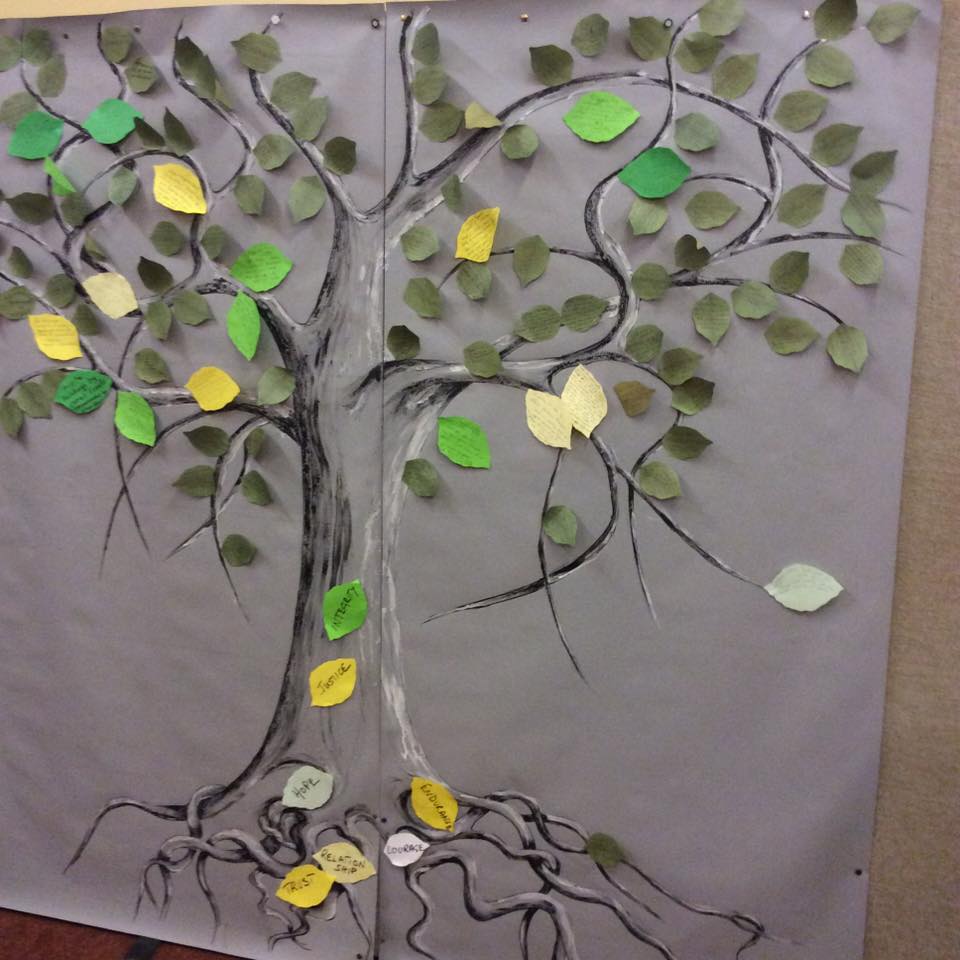
As the conference began we were shown a drawing of a winter tree with no leaves. We were asked to write aspirations, inspirations, hopes, reflections and concerns on paper leaves and stick them on the tree over the week end. On my leaf, the one and only leaf I took, I wrote ‘Remember Rahmat and Nazar’. These four words came from a very deep place inside me and have a real story attached to them.

One of our guests at St Francis House was a young man named Rahmat. He was Hazara from Afghanistan, as were all our Afghan guests. One wet and cold day in May, 2009, Rahmat went to Eaton House in Hounslow for his routine signing. He never returned to us. He was detained and was told that he would be removed back to Afghanistan. We visited him several times during the weeks before his removal. He was in one of the detention centres in Gatwick. Efforts to obtain his release failed and on our penultimate visit he had a request for us. An Afghani teenager, Nazar, had been in the detention centre for several months. He was told he could leave if he had somewhere to stay. Rahmat asked if he could come back with us to St Francis House. We said yes. We made arrangements with the authorities and Nazar was allowed to come and live with us. So, on our final visit to Rahmat on the day before his removal, after an emotional farewell, we met our new young friend, Nazar. It was as if Nazar were Rahmat’s farewell gift to us and it says much for Rahmat’s generosity of spirit that he took Nazar under his wing at a painful time for himself. Even more poignant is the fact that Nazar was not Hazara but Pashtun but this mattered not one bit to Rahmat; Nazar was a youngster in need of help and Rahmat helped him.

Nazar adapted really well to life in Oxford. He made friends with other young teenage asylum seekers, played cricket and displayed intelligence and resourcefulness. His parents had been fearful that he would be forced to join the Taliban and had sent him out of Afghanistan, He followed the long dangerous route we know so well now and ended up with us. Not for long though. He had to sign at Eaton House every fortnight. I accompanied him for the first couple of times but then he went alone. For some reason in the summer of 2009 I went with him again. He didn’t come out for a long time so I went to enquire where he was and was told he was being detained in Colnbrooke, Heathrow. Visits to Nazar in Colnbrook were distressing; he was distraught each time I went and we had such a sense of powerlessness. However, one evening in August I heard the front door open and there was Nazar, beaming from ear to ear. They had released him with no explanation. All was not well, however, as he had paperwork to say that he would be tagged the following day and subject to curfew. One of our other guests explained this to Nazar and he became thoughtful. The next day he disappeared before the security man came.

Over the next few months Nazar telephoned just to say he was O.K. Although I haven’t heard from him for a long time he is always in my heart. As is Rahman, back in Afghanistan, married with children but finding it difficult to find work. Because of the way the stories of these two young men interweave they have a special place in my memory but all the guests who lived with us at St. Francis House are special and have their own stories of courage and endurance.

It was an awareness that asylum seekers and refugees are human beings with names, stories, loved ones, joys and sorrows which impelled me to write the names of Rahmat and Nazar on the tree at Woodbrooke.

The tree started as a winter tree with bare branches but ended the week end as a tree in full leaf and flower. I stayed an extra night at Woodbrooke and the chilly but bright early Monday morning sent me to T.S. Eliot’s ‘Little Gidding’ and hiss musings on midwinter spring ‘when the short day is brightest with frost and fire’.
Inspired by our winter tree bursting into life, one participant quoted from the Book of Revelation 22:2, echoing Ezekiel 47:12:

On either bank of the river were the trees of life, which bear twelve crops of fruit in a year… the leaves of which are the cure for the nations.

A Journey to Russia – Impressions of Saint-Petersburg

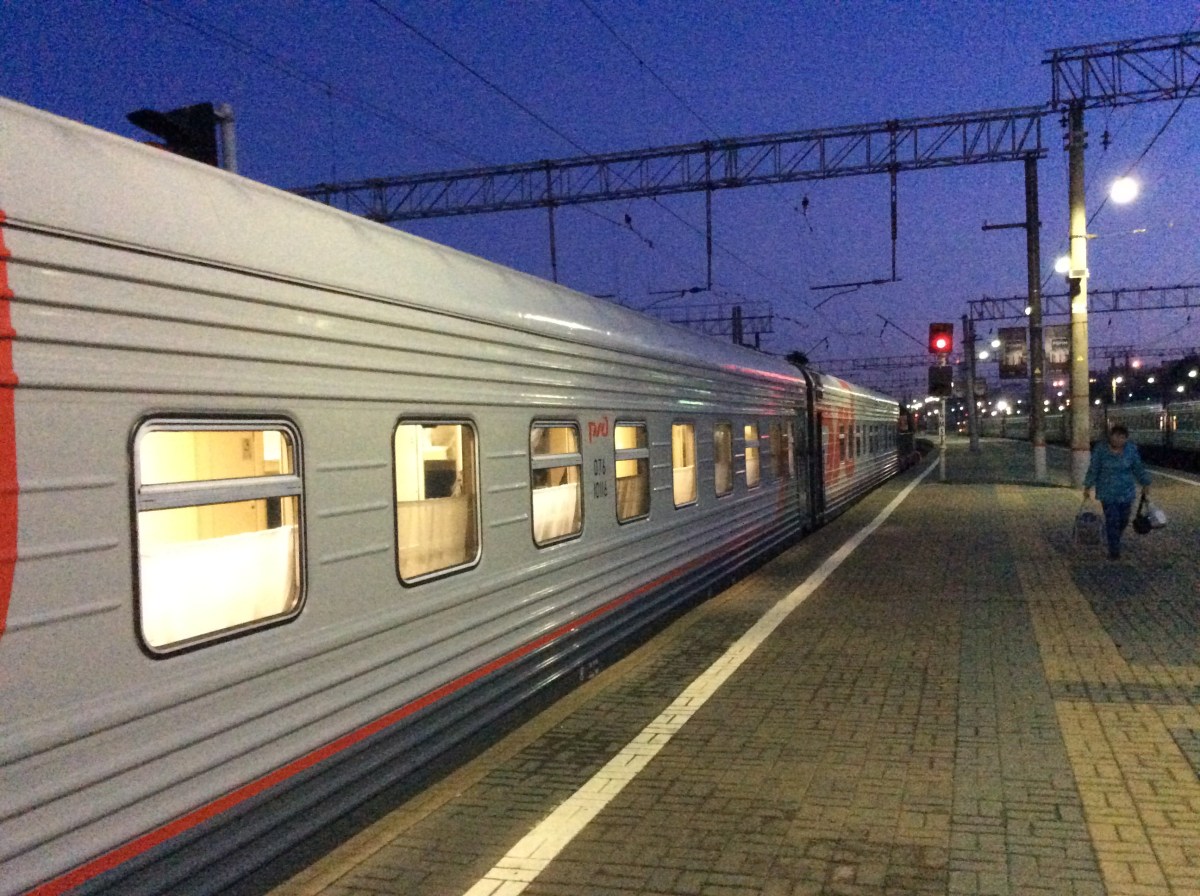
On Sunday, 23 October, Brian, David, Erica and myself took the fast train from Moscow to Saint-Petersburg. We began a five day journey through this remarkable city, accompanied by Volodya, our intrepid guide and interpreter Our itinerary included tours of museums and visits to projects working for the most vulnerable in the city. In between we met people in their homes and eating places and heard many opinions and many stories. For me, the stories tell me more than the opinions.

It was interesting being in this complex and historically important city. While being aware of the breathtaking beautiy of this ‘Venice of the North’ I never forgot the human cost of its construction. In order to make real Peter the Great’s audacious vision of a magnificent city creating a window on Europe, thousands of slave labourers died as its magnificent buildings took shape.

Our knowledgable guide shepherded us through the city he obviously loves and we found ourselves caught up in his enthusiasm. With him we visited the Hermitage, the Summer Garden, the Church on the Spilled Blood and St Isaac’s Cathedral. I think my favourite tourist exclusion was our boat trip on the River Neva. This was on a chilly but sunny day and I was delighted to find that I could follow the Russian commentary, not with ease but I had some idea of what we were being invited to look at! My spoken Russian is really weak but I did notice in our various encounters that I understood a little of what was being said before the interpretation.

Ou guide knew of my interest in Russian literature and he pointed out places associated with Pushkin and Dostoevsky. As a result I’m re reading ‘Crime and Punishment’ and Pushkin’s great poem, ‘The Bronze Horseman’.

We learned something of the challenges of life in this city for the poorest people when we visited two charities and heard about these issues from the workers. They told us, and others confirmed this, that the most vulnerable people in society are the elderly. Pensions are meagre and older people are susceptible to scams which can result in them losing their modest accomodation. It was heartwarming to see the genuine concern of the young workers at the homelessness project for the elderly.

On an overcast and snowy morning we went by bus to the Piskaryovskoe Memorial Cemetery. In silence we reflected on the hundreds of thousands who had died during the nine hundred day Siege of Leningrad during the Great Patriotic War. Our guide told us that his mother had been a young woman during this tragic time and this reinforced our awareness that everyone we met in Saint-Petersburg had relatives who had lived through it, and sometimes had died during it. We learnt that the experience of war on its own soil has given the Russian people horror at the thought of war again. Here is a
translation of a text carved on a granite wall at the cemetery:
Here lie Leningraders
Here are city dwellers – men, women, and children
And next to them, Red Army soldiers.
They defended you, Leningrad,
The cradle of the Revolution
With all their lives.
We cannot list their noble names here,
There are so many of them under the eternal protection of granite.
But know this, those who regard these stones:
No one is forgotten, nothing is forgotten.

I’ve spoken about the visits to people’s homes and we were shown warm hospitality. I just want to mention one woman who really impressed me. I shall call her Katya. She is a bit younger than I and a lively, friendly woman. Soon after our arrival she showed us several large photograph albums which contained hundreds of photos of her family. Her father had been a keen amateur photographer. While looking at the albums we learnt about her life and the fact that her father spent some years in the Gulag. She said this probably saved his life as it meant he wasn’t fighting in the war. As Katya spoke, and like many Russians I’ve met she told a good story, I was struck forcibly by the awareness that life in Russia for those of our generation was vastly different from life in Britain. This is why it is so tragic and unacceptable that elderly Russians are neglected.

The four of us had long journeys ahead to reach our respective homes and I, for one, appreciated the hours spent at the airport as I was able to reflect on all we’d experienced. One final anecdote though. As I’ve mentioned this was my fourth visit to Russia and on the other visits I’d spent time in Perm. The friendly woman on the British Airways desk at Domodyedovo who took care of my disability assistance, was from Perm! What a coincidence!

A Journey to Russia – Memories of Conversations – The Gulag and Human Rights

After our meeting at FHM on Thursday, we went to the Museum of the History of the Gulag. For us this was a preparation for our visit on Friday to the Memorial Human Rights Centre.

The Gulag Museum was relocated and reopened last year and it is a sobering experience to walk through the exhibits and, in my case, to listen to the audio descriptions of the various areas. I read a BBC News report about the reopening of the Museum which pointed out that recent Government policy has been to play down Stalin’s record of terror and instead speak more about his role in defeating Nazi Germany in the Great Patriotic War. This is not to say the terror did not happen, just that the blame was not all at Stalin’s door. This seems to me to be a sensitive subject and I was not ready on this visit to raise it with anyone.

On Friday morning we went to visit representatives of the Memorial Human Rights Centre. With regard to the Gulag Museum, Memorial told us that they had provided the bulk of the archive material and exhibits but I got the impression that that was the extent of the contact.

I had heard of Memorial’s historical work when I learnt about Perm-36, a museum created on the site of a forced labour camp outside Perm, a city I have visited three times. As I understand it, and I could be mistaken, Perm-36 used to be a Memorial project and we learnt that now it is administered by local government. Again, I felt unable to pursue this further on this occasion but I am going to make some enquiries. I think, and again I could be wrong, that one difficulty is that Perm-36 housed nationalist prisoners from former Soviet states and the recent upheavals in these states make this faxt an uncomfortable one. In holding up Perm-36 as an example of Soviet repression it might be thought that the aforementioned nationalist prisoners were seen with sympathy as they had been imprisoned there.

Memorial is a human rights organisation, an historical museum and archive, and an educational forum. They work within the states of the former Soviet Union and, as laid out in their Annual Report 2013-14, their human rights work covers; identifying and documenting human rights abuses, distributing information about human rights abuses, providing legal aid to victims, representing victims in domestic and international courts, writing reports and analysis and presenting these at meetings in Russia and abroad.

The historical archive and the educational programmes serve to keep alive the memories of the victims of the Gulag and to show younger generations that the time of terror is part of the history of Russia. Remembering helps to ensure that it cannot happen again. Young people visit Memorial and engage in educational programmes and study exhibitions like “Art and Everyday Life in the Gulag”.

During our visit we were shown precious archive material which had been lovingly preserved by families of those in the camps, such as a note written on a flimsy cigarette paper and thrown from a train window in the hope that it reached the recipient. It did!

In contrast to this single testimony we were told of the largest collection of letters in the archive; thousands of letters, delivered to the Memorial office in three trunks, written by Lev and Svetlana Mishchenko during their fourteen years separation, first by his being in the army during the Great Patriotic War and then by his time in the Gulag. Lev sent the letters Svetlana wrote to him back to her so that a detailed record could be kept. British historian, Orlando Figes has chronicled their story in ‘Just Send Me Word’.

Memorial has been under threat for the past few years as it was considered to be a ‘foreign agent’ as it receives money from overseas for its work. A list of supporters includes the Embassies of Great Britain, France and the Netherlands as well as Amnesty International. One of our group spotted a donor he’d heard of and it gave him pause for thought but I think I’ll check out the donor groups which are unfamiliar to me, just for interest.

I believe that Memorial does great work and the staff we met are certainly committed. As we were leaving we saw boxes of candles and were told that on the following Saturday there would be a vigil in Moscow where the victims of the Gulag would be remembered with the lighting of candles and the reading out of names.

A fitting memorial.

A Journey to Russia – Memories of Conversations -Meeting Quakers in Moscow


I’m letting myself off the hook by calling these pieces ‘Memories of Conversations’. This is by no means an exhaustive report of the many conversations we had but is simply a record of what I remember and what made the deepest impression on me.

During our three full days in Moscow we spent time at Friends’ House Moscow and attended a Meeting for Worship. A staff member at FHM gave us an overview
of the work they are engaged in and the challenges this presents. Here is a quotation from the most recent annual report:

“Friends House Moscow is a small non-governmental nonprofit organisation that funds projects for peace and civil society in the former Soviet Union. FHM supports projects which work in such areas as human rights, education, restorative justice and non-violent communication. Each project also furthers social goals such as grass-roots collaboration, equality and non-violence.
The work of Friends House Moscow reflects the deepest values of the Society of Friends (Quakers).”

FHM also engages in translating Quaker texts into Russian. We were shown examples of the most recent publications.

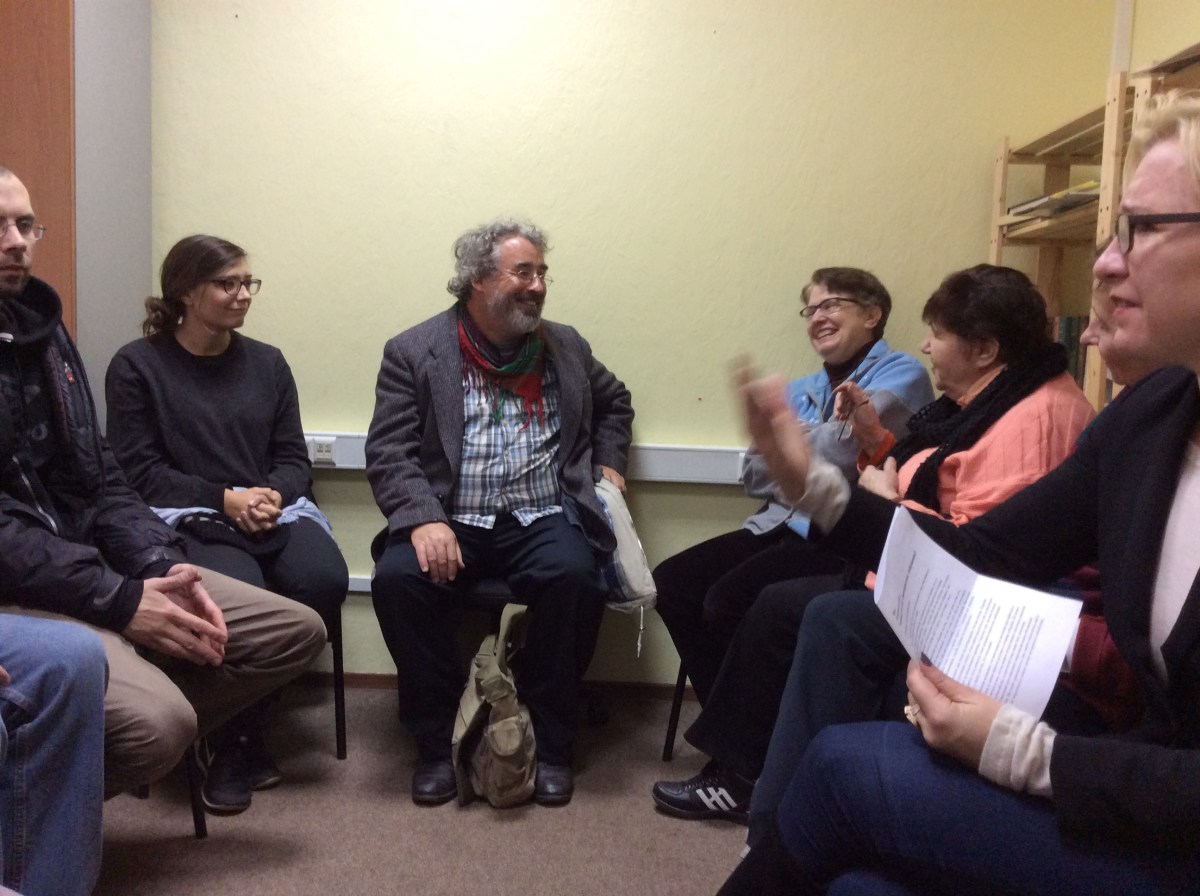
On Saturday afternoon we attended Meeting for Worship and met some of the local Quakers. After Meeting we had opportunity for tea, cake, informal discussion and sharing of experiences. All four of us found this encounter enjoyable and informative. I’ve found the Russians I’ve met on my visits to the country to be very forthright and disinclined to engage in small talk and this can lead to lively debate. One point I remember which was repeated by other people we met was that as Russia had suffered so much in what we call World War Two and Russians call The Great Patriotic War, they are determined that they should never experience war again.

As a Quaker I was so happy to meet up with Moscow Friends. I have been asked to serve on the Board of FHM and have accepted. I look forward to further contact with these warm hearted and hospitable people.

A Journey to Russia – Overview


A week ago in the early morning of Saturday, 29 October, I said goodbye to my three travelling companions in a chilly Moscow railway station. We had spent ten days in Moscow and Saint Petersburg, meeting and talking to Russians about life in Russia and the current tensions between Russia and the West. We are part of the group Voices for Creative Nonviolence. My three companions, Brian, Erica and David, are from the U.S. where VCNV was formed during the 90s. A UK branch was formed in 2012 when a group of us travelled to Afghanistan to visit the Afghan Peace volunteers. Thee have been several delegations since then, both from the U.S. and Britain.
This small VCNV visit to Russia is a recent development and I feel proud to have been part of it. So, what did we do and, more importantly, what did I learn? I can’t speak for the others and I look forward very much to reading their reflections but I thought that for myself I’d like to put down a few impressions of our visit and then write more pieces focusing on specific aspects.
This was my fourth visit to Russia and I have written elsewhere in this journal about previous visits. This was the first time, however, that I had spent more than a few hours in Moscow and the first time I’d visited Saint Petersburg.
We stayed in hostels in both cities. They were warm and welcoming places to stay. In Moscow we were joined by a guide and interpreter, Salla, who was an invaluable companion. In Saint Petersburg Volodya, a native of the city, acted as guide and interpreter. His love for his city inspired us as we walked the streets once walked by Pushkin, Dostoevsky and many other writers and artists.
During our ten days we met Quakers in Moscow, representatives of Memorial, a human rights group in the same city, and, in Saint Petersburg, we met groups working with vulnerable people in the city, language students and friends of Volodya and his wife who invited us int their homes.
We visited various museums in both cities connected to the recent history of the former USSR as well as the world famous Hermitage. We also visited several churches in both cities which were either places of worship or museums. A particular highlight for me was the boat trip we took on the Neva and the canals of Saint Petersburg.
Since returning I have been reflecting on this visit against the background of anti Russian sentiment presented in the media. I keep revisiting in my mind the people we met and the things they said. My next entry will focus on this.

A Journey From Roman Catholicism To Quakerism

The first Quakers I met lived in a small mining village in Yorkshire in the north of England. They were a family who were enthusiastic about different churches working together. At that time, the mid 1970s, I lived in a small religious community and worked as a teacher in a local Catholic school. I remember being attracted to Quaker faith and practice at the time but felt that to leave Catholicism and my religious order was too great a leap.

I was brought up as a Catholic in my home city of Bradford, also in Yorkshire. At the age of nineteen, in 1966, I joined a Catholic religious order called the Sisters of Christ. The sisters ran schools in England and I became a teacher.

It was a very exciting time to be a Catholic and a nun. In the 1960s there was a Council of the Church, the Second Vatican Council, which revitalised many aspects of Catholic life, from liturgical change to deeper relations with other Christians and other faiths. Catholics in many countries became actively involved in issues of justice and peace. This appealed to me too and I was able to work with others on issues such as nuclear disarmament and inequality in society.

In 1993, after several happy years working as a school chaplain, again in Yorkshire, I became ill. In 1994 I moved to a community of our sisters in London and began working with homeless people. It was at this time that I heard about the Catholic Worker Movement.

Dorothy Day, whom Pope Francis has quoted many times in his recent visit to the USA, co founded the CW in 1933 in New York. Catholic Workers run Houses of Hospitality for vulnerable people and actively work for peace, sometimes using nonviolent direct action to highlight the injustice of the military industrial complex. Most CW communities are in the USA but there are CWs in Britain, Holland, Germany, New Zealand and Australia. With the support of my religious order I was able to spend two years living and working with CW communities in Los Angeles, Washington D.C and New York. During this time I learnt a great deal about Dorothy Day and the CW Movement. I also met other peace activists, especially those acting from Christian conviction. In 2001 I was arrested for the first time outside the White House on Holy Saturday.

On my return to England I joined the CW community in Oxford. This was again with the support of the Sisters of Christ and I shall always be grateful for their encouragement. However, it became apparent to me and to my superiors that this work of hospitality and resistance to war was where God wanted me to be. After three years of discernment it was decided that I should leave the Sisters in order to carry on this work. The Sisters loved the work of hospitality but were uneasy about the direct action, especially as I have been arrested several times since 2004 when I came to Oxford. I officially left the Sisters of Christ in 2009, with sadness but with the blessing of my superiors. I still keep in contact with the sisters.

As soon as I came to Oxford in 2004 I met Quakers. Oxford has a large active Meeting and many of the people I met on demonstrations against war and nuclear weapons were Quakers. I began to deepen my knowledge of the Society of Friends by attending Meeting for Worship and reading Quaker literature. I realised that the non hierarchical nature of the Society, the mystery in the silence at Meeting and the Testimonies answered a great longing in me for a simpler way of following Jesus and putting his Gospel teaching into practice. For a few years there was certainly a tension in me for I was, after all, part of the Catholic Worker Movement. Again I set out on a journey of discernment with the help of two guides, a Catholic and a Quaker. I also did a silent retreat. For a while I attended both Mass and Meeting for Worship on Sunday but found this cumbersome and confusing. I decided to focus on Meeting for Worship and see where God would lead.

In 2012 I went to Afghanistan on a peace delegation with three other women from Voices for Creative Nonviolence UK. I had already been attending Meeting for two years and was deeply moved by the support I received from Oxford Quakers as I prepared for this visit. I decided on my return to apply for membership and have now been a member for over two years.

Until June of this year I continued to work at the Catholic Worker house of hospitality for refugees in Oxford. Becoming a Quaker has made no difference to my commitment to hospitality and resistance, indeed it has strengthened it. For practical reasons the house had to close in June so at the time of writing this I am disowning the best way to go forward in the remaining years of my life as a Quaker and a peace activist.

Last year I visited Perm in Russia as part of the exchanges between Oxford and Perm who are twin cities. On my return I attended a conference at Woodbrooke, the Quaker Study Centre in Britain, about Quakers in Russia where I met Natasha and Sergei from Friends’ House Moscow. In September I met Natasha again in Moscow, on my way back from a second visit to Perm. This contact with Russian Quakers and other Friends worlwide who are similarly connected to FHM has added a new and most welcome aspect to my life as a Quaker.

As an elder I am involved in the life of the Meeting and am also part of the Oxford Friends Action on Poverty, as well as being a member of our group working to commemorate the beginning of conscientious objection in 1916. To close the circle, the mother in the Quaker family I met forty years ago was the daughter of a noted British CO of the First World War, Corder Catchpool.

Russian Soul -Rubber Soul – And Much, Much More!

On Saturday I took a trip across the Pennines to Liverpool to hear Karavai, the balalaika quartet from Perm, Russia, play Beatles tunes. The midday concert was part of the International Beatleweek Festival where musicians from around the world come to Liverpool each year to play the songs of the Beatles in many different musical styles and in different venues in the city, primarily the Cavern!
The Saturday concert was free and took place in the magnificent Central Library, minutes away from Lime Street Station. Karavai opened the session with a fifty minute magical mystery tour which took my breath away. I didn’t stay after the performance but understand that several of the international bands came to play in the Library up until six o clock.
When Karavai began to play ‘Here Comes The Sun’ the audience was sparse but as the music wove its magic the appreciative applause after each piece became more and more enthusiatic. As well as the four string players, the group has a keyboard player and percussion. Together they created a variety of moods from the familiar much loved melodies.
‘Here Comes The Sun’ brought tears to my eyes. It was gentle at first, just piano and then the whole ensemble took the simple evocative melody away and created something to uplift the heart. I think I cried because it made me remember how much I loved the Beatles as a teenager and how much joy they’d given to my youthful self. (And it is George’s song: we all had our favourite Beatle!) Even more than that, though, I had tears of joy for the fact that the musicians before us were from Perm, a city I have grown to love in a country which is becoming more and more important to me.
I’d like to mention two other arrangements which particularly set my feet tapping. Karavai’s version of ‘Eleanor Rigby’ is in the style of a traditional Irish band and “Can’t Buy Me Love’ soars away on jazz improvisation.
I bought the CD and am listening to it as I write. Who would have thought that over fifty years since I saw the Beatles in Bradford I would be sitting listening in Liverpool to a group of Russian musicians interpreting so creatively the musical heritage of a generation?